Dual-Camera vs Side-View Videoscope Which Is Better for Internal Inspection
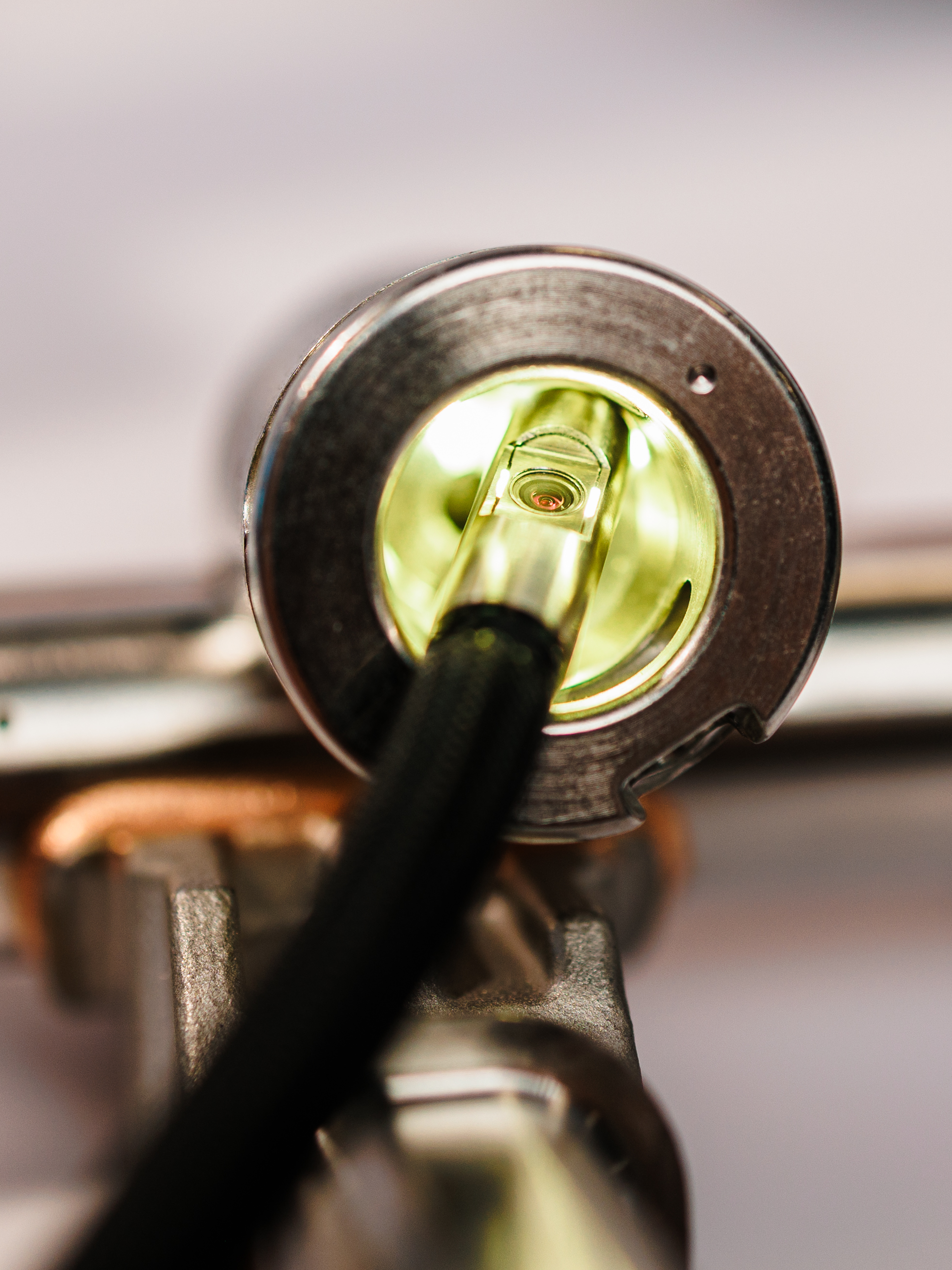
Learn the practical difference between dual-camera and dedicated side-view videoscopes, and when each is better for pipe welds, sidewalls, blind holes and internal inspection.
Which is better: a dual-camera or side-view videoscope? A dual-camera videoscope is usually better when the operator needs both forward viewing for navigation and side viewing for wall, weld or tube inspection during the same inspection. A dedicated side-view probe is better when the inspection target is specifically located on a sidewall, thread root or near the bottom of a blind hole and a direct 90-degree viewing direction is more important than forward navigation.
Dual-Camera vs Side-View Videoscope: Which Is Better for Internal Inspection?
Viewing direction is one of the most important — and often misunderstood — factors when selecting an industrial videoscope.
A standard forward-view probe looks straight ahead. This is ideal for navigation, locating internal features and general inspection. However, many defects are not located directly in front of the camera. They may be found on a pipe wall, around a weld seam, inside a cross hole, on a thread root or close to the bottom of a blind hole.
For these applications, two common solutions are:
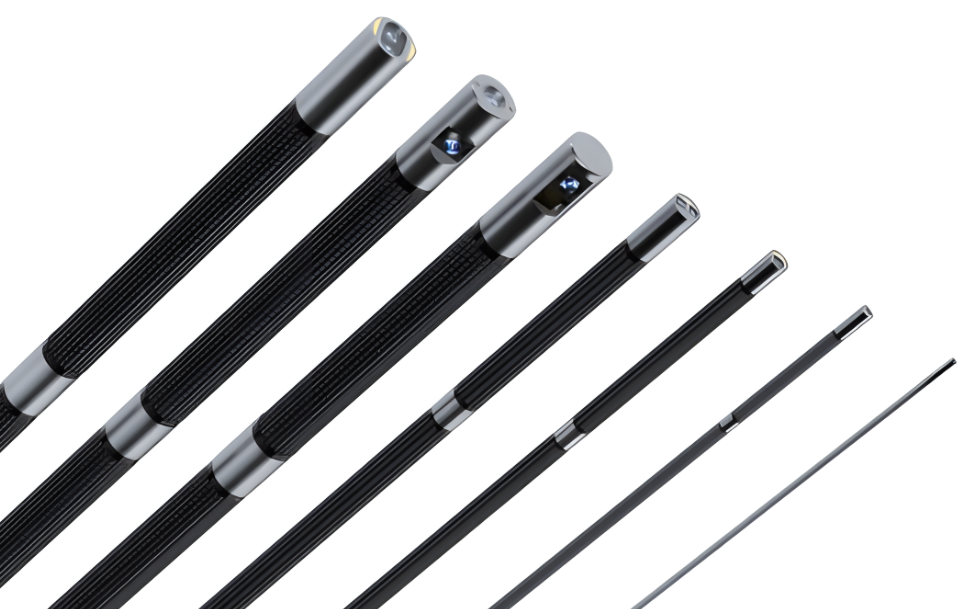
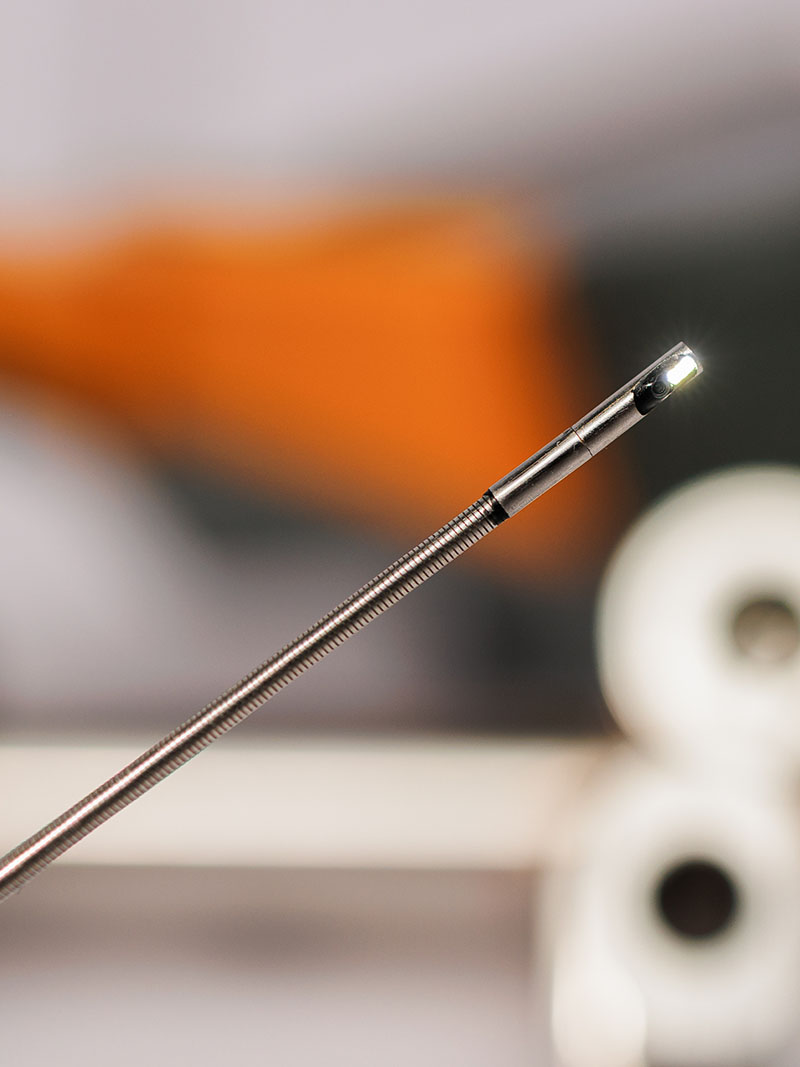
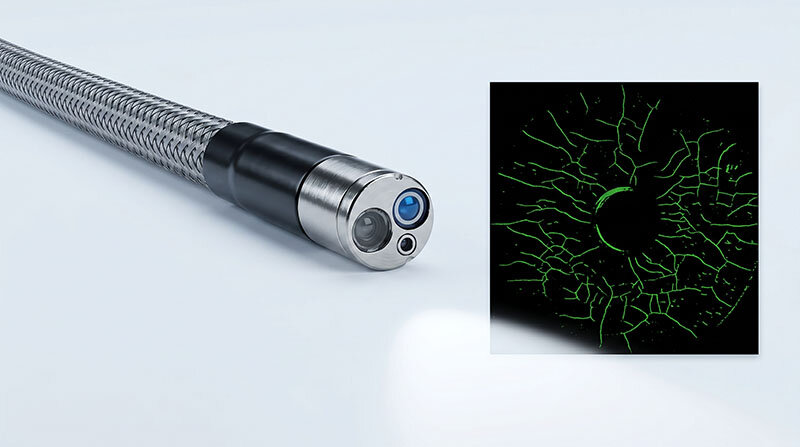
Dual-camera videoscope probes with both forward-view and side-view cameras
Dedicated side-view videoscope probes with the optical axis directed toward the sidewall
Neither design is universally better. The correct choice depends on where the inspection target is located, how the probe reaches it, how much space is available and whether forward navigation is still required.
What Is a Dual-Camera Videoscope?
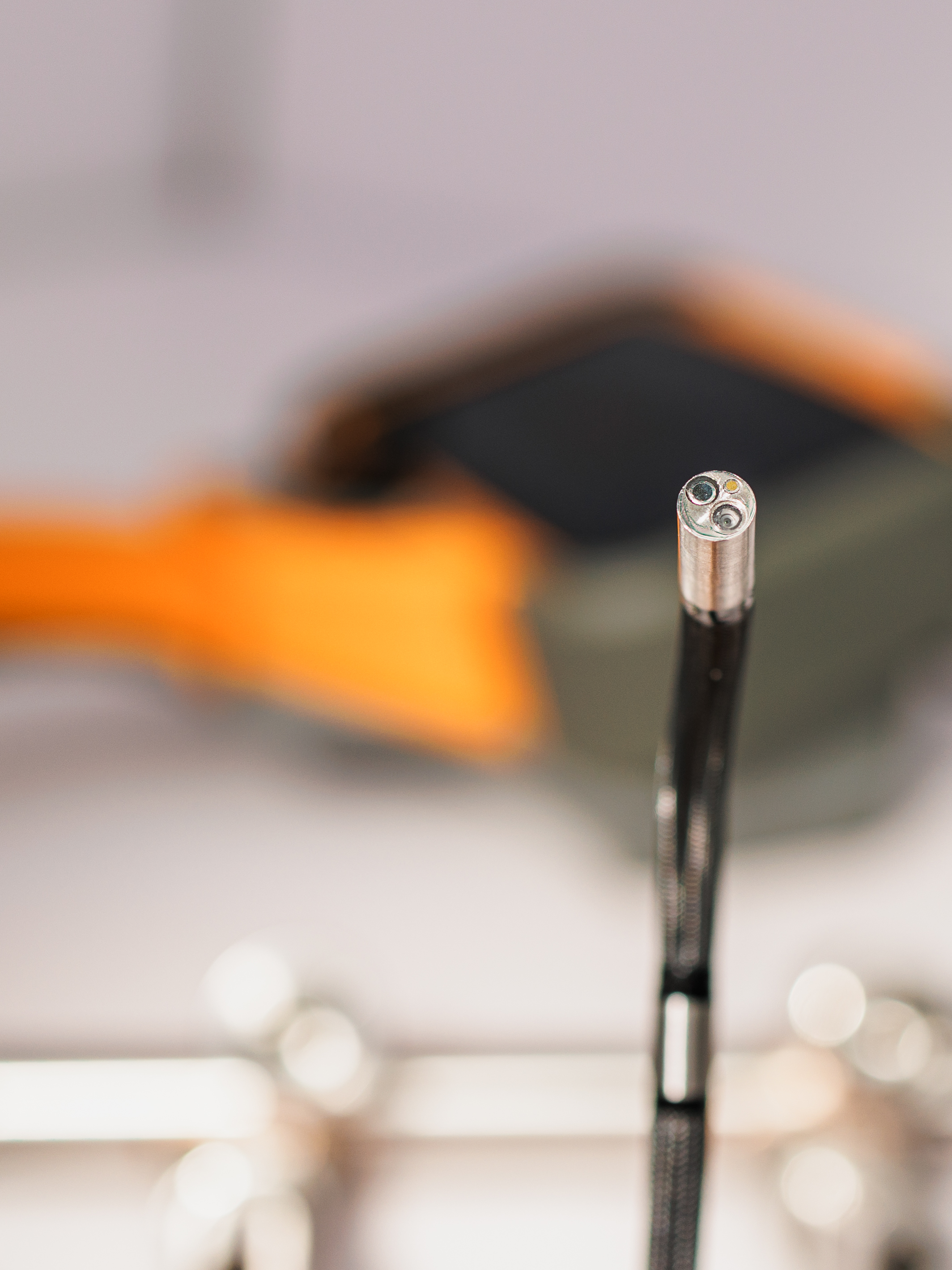
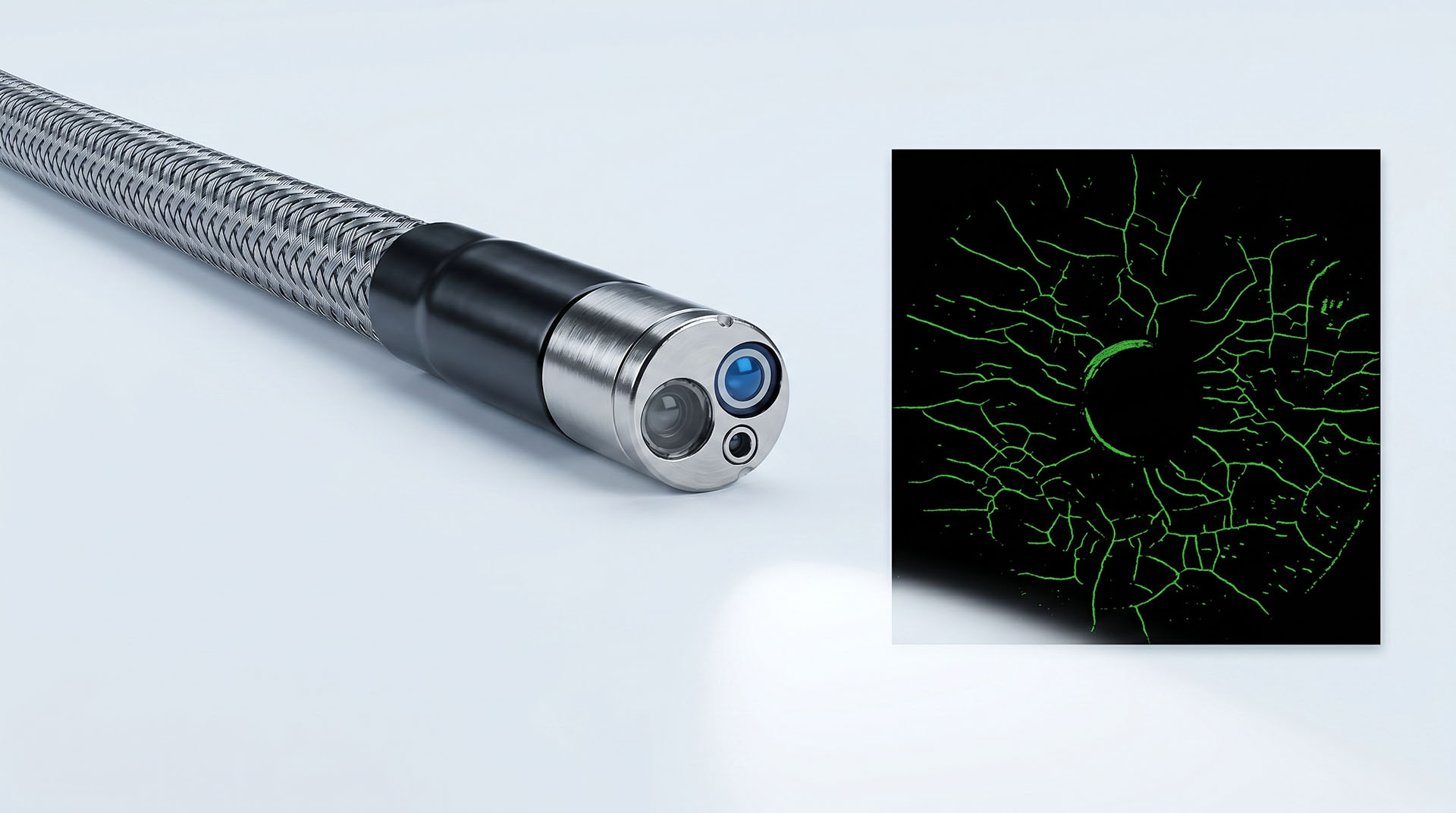
A dual-camera videoscope probe integrates two camera directions into the same distal probe assembly:
Forward-view camera for navigation and general inspection
Side-view camera for viewing walls, welds and perpendicular internal surfaces
The operator can change between forward and side viewing without removing the probe and installing a different probe.
This is particularly useful when the inspection process itself requires both functions.
For example, inside a pipe the forward camera can be used to:
Navigate through the tube
Locate a weld position
Identify bends or internal obstructions
Control insertion depth and orientation
Once the target area is reached, the side camera can be used to inspect the pipe wall or weld more directly.
The main advantage of a dual-camera probe is therefore not simply “two cameras.” It is the ability to combine navigation and sidewall inspection in one inspection pass.
What Is a Dedicated Side-View Videoscope?
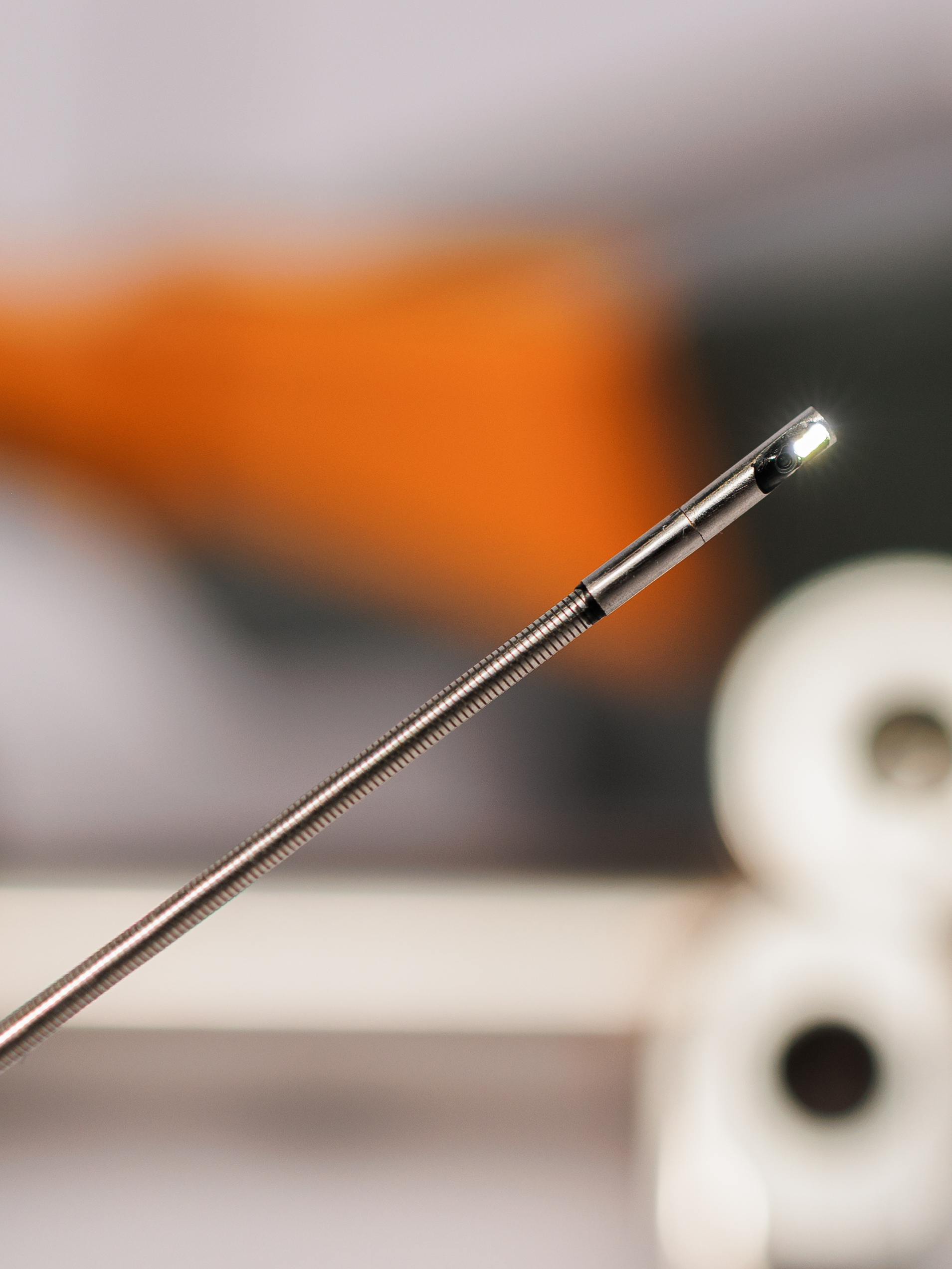
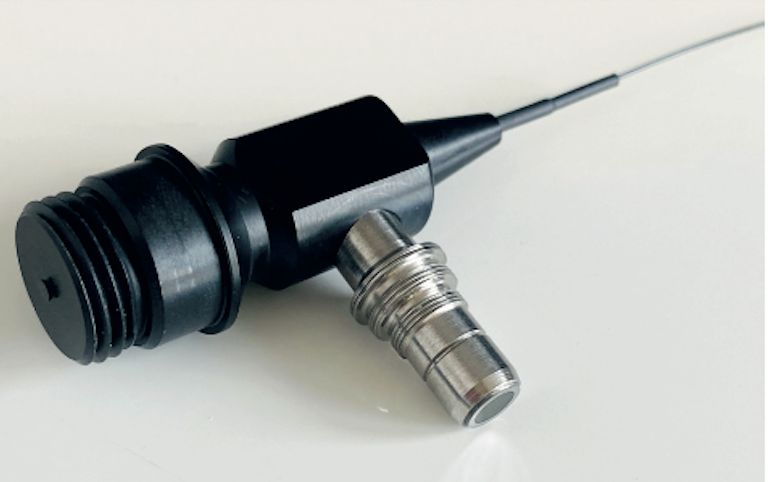
A dedicated side-view videoscope is designed primarily to observe surfaces located approximately perpendicular to the probe axis.
Instead of looking straight ahead, the camera or optical system is directed toward the side of the probe.
This makes dedicated side-view configurations particularly suitable for:
Blind-hole sidewalls
Thread roots
Cross holes
Internal grooves
Pipe walls
Weld surfaces
Features located very close to the distal end of the probe
In these applications, the main inspection target is already known to be on the side. A forward-view camera may therefore provide little additional inspection value.
The Main Difference: Navigation vs Direct Sidewall Inspection
The easiest way to understand the difference is to ask one question:
Do you need the forward camera to reach and locate the inspection target?
If the answer is yes, a dual-camera probe can provide a significant workflow advantage.
If the target is a precisely defined sidewall feature and the inspection geometry is already known, a dedicated side-view probe may provide a more direct solution.
| Inspection Requirement | Dual-Camera Probe | Dedicated Side-View Probe |
|---|---|---|
| Forward navigation | Excellent | Limited / not primary purpose |
| Direct sidewall inspection | Excellent | Excellent |
| Switch between front and side during inspection | Yes | No |
| Pipe and tube inspection | Very suitable | Suitable when sidewall is the main target |
| Weld inspection | Very suitable | Suitable for dedicated weld geometry |
| Blind-hole sidewall inspection | Possible depending on geometry | Often preferable |
| Thread-root inspection | Application dependent | Strong choice |
| General-purpose inspection | More flexible | More specialized |
| Simple known side-view target | May provide unnecessary complexity | Purpose-built solution |
Dual Camera for Pipe and Tube Inspection
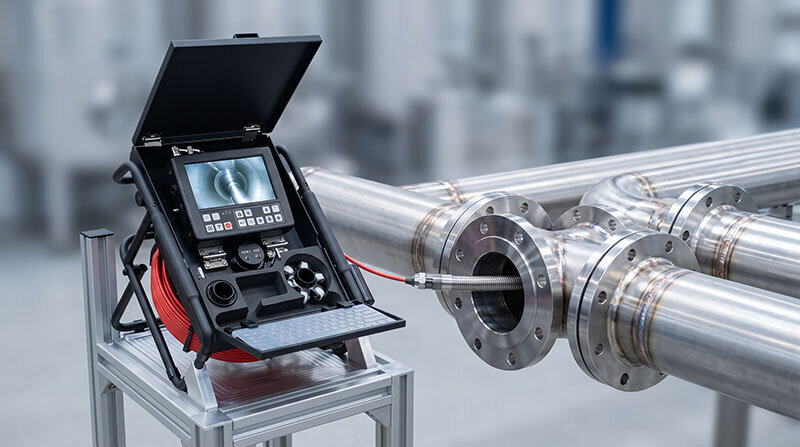
Pipe inspection is one of the clearest applications for a dual-camera videoscope.
A pipe creates a special optical problem: the probe travels along the same axis as the pipe, while the inspection target is often located on the wall.
With a forward-view camera, the operator can see where the probe is travelling. However, the pipe wall may appear at a difficult angle, especially in relatively small-diameter tubes.
A side camera gives a more direct view of the wall.
This is particularly useful for:
Sanitary pipe weld inspection
Process piping
Internal circumferential welds
Small tube inspection
Corrosion or contamination checks
Surface-condition inspection
For sanitary and process-pipe applications, the dual-camera workflow can be especially practical because the operator can first locate the weld with the forward camera and then inspect the weld surface using the side camera.
Why Articulation Alone Is Not Always Enough for Sidewall Inspection
A common question is whether a side-view camera is necessary if the videoscope already has 2-way or 4-way articulation.
In a sufficiently large cavity, an articulated forward-view probe can often be bent toward a sidewall. In that situation, a standard forward-view probe may be completely adequate.
However, articulation requires physical space.
Inside a small tube, the probe may not have enough clearance to bend sufficiently to place the forward camera perpendicular to the wall.
This creates an important practical rule:
Large cavity + sufficient articulation space → a forward-view articulated probe may inspect the sidewall effectively.
Small tube + restricted bending space → a true side-view camera can provide a much more useful viewing angle.
This is why side-view and dual-camera solutions are often important in small-diameter pipe and weld inspection even when the probe already has articulation.
When a Dedicated Side-View Probe Is Better
A dedicated side-view probe becomes particularly valuable when the inspection target is geometrically fixed and located close to the side of the probe.
Blind-Hole Inspection
Blind holes are a good example.
The operator may need to inspect the sidewall close to the bottom of the hole rather than the bottom surface itself.
A forward-view probe naturally points toward the bottom. To inspect the wall, it must be articulated sideways — but there may be very little space between the camera tip and the end of the hole.
A dedicated side-view configuration can observe the wall directly without requiring the same amount of bending space.
Thread-Root Inspection
Thread roots, internal grooves and similar circumferential features are also well suited to dedicated side viewing.
The inspection objective is not simply to see inside the hole. The objective is to observe a specific surface at approximately 90 degrees to the probe axis.
In such cases, the location of the side-view optical center relative to the distal end can be as important as probe diameter.
Near-Bottom Sidewall Inspection
Some applications require inspection only a few millimeters from the end of a blind cavity.
Here the design of the distal tip becomes critical. A long hard tip may physically prevent the side-view optical system from reaching the required inspection position.
For this reason, specialized side-view applications should confirm:
Hole diameter
Hole depth
Distance from the bottom to the target
Required side-view focus distance
Position of the optical center
Distal-tip length
These dimensions can matter more than the nominal probe diameter alone.
When a Dual-Camera Probe Is Better
A dual-camera probe is usually the stronger option when the inspection route is not completely predictable or when the operator must repeatedly alternate between navigation and surface inspection.
Typical situations include:
Long pipe or tube inspection
Weld inspection where the weld must first be located
General industrial maintenance
Internal passages with multiple features
Applications requiring both end-face and sidewall inspection
Inspection work where removing and reinserting the probe would be inefficient
Instead of optimizing for one single viewing direction, the dual-camera probe gives the inspector more flexibility during the actual job.
Dual Camera Is Not the Same as an Interchangeable Side-View Tip
These terms are sometimes confused, but they describe different optical architectures.
A dual-camera probe contains separate forward and side cameras in the probe assembly.
A dedicated side-view probe is built primarily for side viewing.
An interchangeable optical tip adapter, used by some videoscope systems, changes the viewing direction by installing a different optical attachment at the distal end.
These solutions are not technically identical and should not be assumed to be interchangeable.
When comparing systems, always confirm whether “side view” means:
A second integrated camera
A fixed dedicated side-view optical system
An interchangeable optical adapter
Or simply an articulated forward-view camera pointed toward the wall
This distinction can significantly affect inspection workflow and probe compatibility.
Does Dual Camera Mean Both Images Are Always Displayed at the Same Time?
Not necessarily.
The camera configuration and the handheld platform both affect how the images are displayed.
For example, within the Inspector Series:
Inspector Plus dual-camera configurations use forward-view and side-view switching.
Inspector Touch dual-camera configurations can support forward/side switching as well as split-screen viewing in compatible configurations.
Dual-camera probes can also be platform-specific, so compatibility should always be confirmed before changing the base unit or ordering an additional probe.
Probe Diameter Still Matters
Adding a second camera into a probe requires physical space.
This means that the desired viewing direction cannot be considered separately from probe diameter.
For any dual-camera or side-view project, confirm:
Actual access-hole diameter
Minimum internal diameter
Required working clearance
Inspection length
Bend radius
Required articulation
Viewing direction
Target distance
Surface condition
A technically attractive camera configuration is useless if the probe cannot safely reach the inspection area.
Long Dual-Camera and Side-View Probes Require Additional Evaluation
Probe length is another important limitation.
A side-view or dual-camera configuration that works well at a short or medium working length should not automatically be assumed to perform identically at very long lengths.
As probe length increases, several factors may become more difficult:
Signal transmission
Illumination
Probe handling
Pushability
Articulation response
Mechanical durability
For long-distance inspection, viewing direction should therefore be evaluated together with probe diameter, working length and the real inspection geometry.
Do not select a long dual-camera probe simply because it appears to offer more functions. Select it only when both viewing directions are genuinely required by the application.
Practical Selection Guide
| Real Inspection Situation | Recommended Viewing Solution |
|---|---|
| Large cavity with enough space to articulate toward the wall | Forward-view articulated probe may be sufficient |
| Small pipe where forward navigation and wall inspection are both required | Dual-camera probe |
| Sanitary pipe weld inspection | Dual-camera probe |
| General inspection requiring both end-face and sidewall observation | Dual-camera probe |
| Blind hole with target on sidewall close to bottom | Dedicated side-view probe |
| Internal thread-root inspection | Dedicated side-view probe |
| Known sidewall target with no need for forward navigation | Dedicated side-view probe |
| Very small access opening | Confirm manufacturing feasibility first; side-view configuration may be limited |
| Very long inspection distance | Evaluate diameter, length, light, signal and viewing requirement together |
What Information Should Be Confirmed Before Choosing?
Instead of beginning with the question “dual camera or side view?”, first describe the inspection task.
| Question | Why It Matters |
|---|---|
| What is the object being inspected? | Defines the real inspection geometry and defect type. |
| Where is the target surface? | Front, wall, weld, thread root or blind-hole bottom require different viewing directions. |
| Do you need forward viewing for navigation? | This is one of the strongest reasons to choose dual camera. |
| What is the minimum access diameter? | Determines which camera configuration can physically enter. |
| How much room is available for articulation? | A forward camera may already inspect the sidewall if sufficient bending space exists. |
| How close is the target to the end of a blind hole? | Distal-tip geometry becomes critical for dedicated side-view inspection. |
| What working distance is required? | The optical focus range must match the actual camera-to-target distance. |
| How long must the probe be? | Very long side-view and dual-camera designs may require additional technical evaluation. |
FAQ
What is a dual-camera videoscope?
A dual-camera videoscope has both forward-view and side-view cameras integrated into the probe. The forward camera is mainly used for navigation and general inspection, while the side camera provides a more direct view of walls, welds and perpendicular internal surfaces.
What is a side-view videoscope?
A side-view videoscope uses a camera or optical system directed toward the side of the probe rather than straight ahead. It is especially useful for sidewalls, blind holes, thread roots, grooves and other features located approximately 90 degrees to the insertion direction.
Is a dual-camera videoscope better than a side-view videoscope?
Not always. Dual camera is usually better when both forward navigation and sidewall inspection are required during the same inspection. Dedicated side view is usually better when the target is specifically located on a sidewall and forward viewing provides little additional value.
Do I need a side-view camera if my videoscope has 4-way articulation?
Not necessarily. In a large cavity, an articulated forward-view probe can often be directed toward the sidewall. In a small pipe or restricted cavity, however, there may not be enough space to bend the probe sufficiently, so a true side-view camera may provide a much better viewing angle.
Which viewing direction is best for pipe weld inspection?
A dual-camera probe is often highly practical because the forward camera can locate and navigate to the weld while the side camera gives a direct view of the pipe wall and weld surface.
Which is better for blind-hole inspection?
If the main target is the sidewall or thread root close to the bottom of the blind hole, a dedicated side-view probe can be preferable. The distal-tip length, side-view optical-center position and required focus distance should be confirmed carefully.
Can a dual-camera probe show front and side views simultaneously?
This depends on the system. Some platforms switch between the two cameras, while others can provide split-screen display. Within the Inspector Series, Inspector Plus uses forward/side switching, while compatible Inspector Touch dual-camera configurations can also provide split-screen viewing.
Is a side-view probe available in every diameter and length?
No. Camera direction, probe diameter and working length are technically linked. Very small-diameter or very long side-view configurations may have additional optical, mechanical or signal limitations and should be evaluated for the specific application.
Can I convert any forward-view probe into a side-view probe?
No. A forward-view probe, dual-camera probe, dedicated side-view probe and interchangeable optical-tip system are different designs. Do not assume a standard forward-view probe can simply be converted to side view without confirming the probe architecture.
Conclusion
The choice between a dual-camera and dedicated side-view videoscope should be based on the inspection geometry rather than the number of cameras.
Choose dual camera when the inspection requires both forward navigation and direct sidewall observation.
This makes it particularly useful for pipes, tubes, welds and general industrial inspections where the operator needs to move through the component and then inspect its walls.
Choose dedicated side view when the inspection target is clearly located on the side and direct 90-degree viewing is the primary requirement.
This is especially important for blind holes, thread roots, grooves and other geometries where there is insufficient space to bend a forward-view probe toward the target.
And in larger cavities, remember that neither solution may be necessary: a correctly selected articulated forward-view probe can often inspect the sidewall effectively.
The most reliable selection process is therefore:
Inspection target → access geometry → viewing direction → working distance → probe diameter → probe length → articulation → final camera configuration.
Choosing the viewing system this way avoids unnecessary complexity and gives the operator a probe that is matched to the real inspection task.
Related Guides: