Industrial Borescope Optics Explained FOV DOV DOF and Working Distance
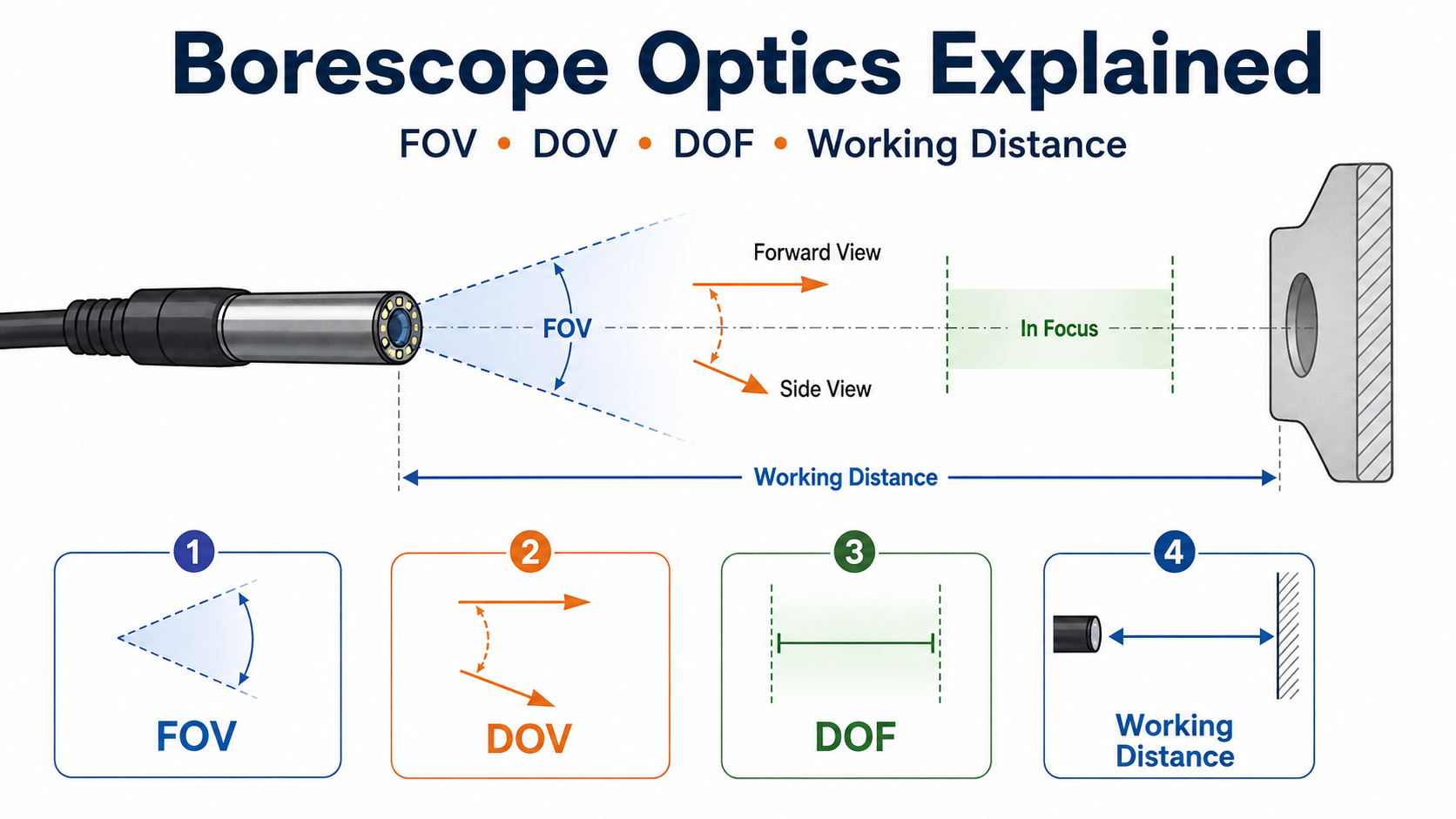
Learn how FOV, DOV, depth of field, working distance and optical distortion affect industrial borescope inspections—and how to select the right optics for real applications.
Industrial Borescope Optics Explained: FOV, DOV, DOF and Working Distance
When selecting an industrial videoscope or borescope, specifications such asField of View (FOV), Direction of View (DOV), Depth of Field (DOF), working distance and image resolutionoften appear side by side in a datasheet.
The difficulty is that these numbers are easy to compare, but not always easy to interpret in a real inspection. A wider FOV is not automatically better. A shorter focusing distance is not always better. A side-view camera is not necessary simply because the inspection target is located on a side wall.
The correct optical configuration should always begin with one practical question:
What exactly needs to be seen, and from what position can the camera reach it?
This guide explains the main optical terms used in industrial remote visual inspection and, more importantly, how they influence real inspection work.
1. What Is Field of View (FOV)?
Field of View describes the angular width of the scene visible through the lens. A wider FOV captures a larger area at the same working distance, while a narrower FOV concentrates the image on a smaller area.
For example, a wide-angle lens can help an operator understand the overall geometry of a cavity and locate the inspection target quickly. A narrower viewing angle can make a smaller area occupy more of the image.
When is a wider FOV useful?
Gearbox interiors
Large mechanical cavities
Castings
Engine chambers
General orientation inside unfamiliar components
Applications where the operator needs to see more surrounding geometry
When can a narrower FOV be useful?
Small surface defects
Specific mechanical edges
Localized weld areas
Detailed inspection of a limited surface
However, a narrower FOV does not automatically mean higher image resolution. Actual inspection detail also depends on the camera sensor, lens design, working distance, illumination, surface condition and image processing.
This is why FOV should never be evaluated as an isolated specification.
2. What Is Direction of View (DOV)?
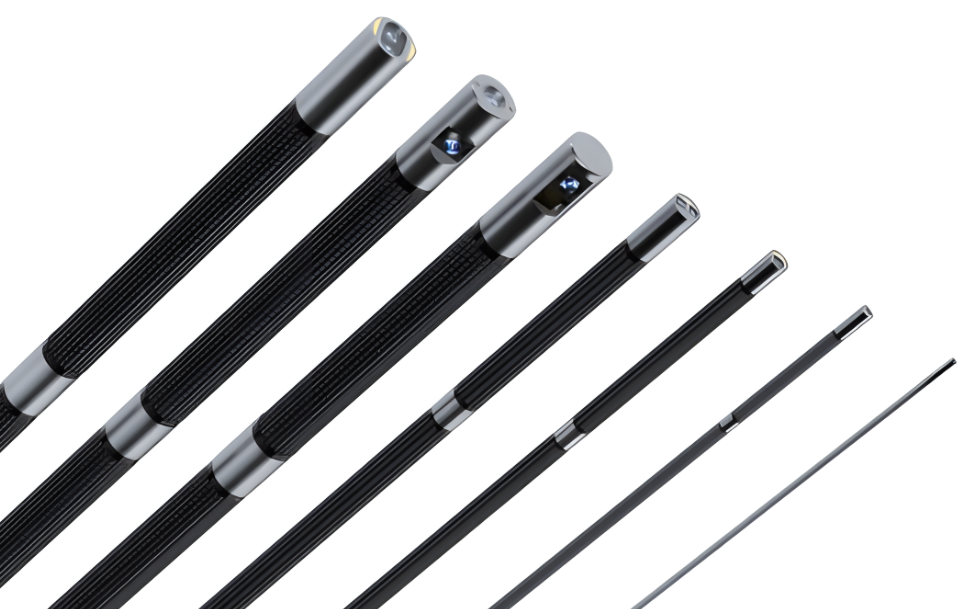
Direction of View describes the direction in which the optical system looks relative to the longitudinal axis of the probe.
Common configurations include:
0° Forward View
Oblique View
90° Side View
Forward view is the most common configuration because the operator can see the inspection path while inserting the probe.
A side-view system is useful when the target surface lies approximately perpendicular to the insertion direction and the probe cannot easily be turned toward it.
Typical forward-view applications
Gearboxes
Engines
Turbines
Mechanical assemblies
Castings
General cavity inspection
An important point is that a customer does not automatically need a side-view camera simply because the target is located on a side wall.
If the inspection space is large enough and the videoscope has effective articulation, the operator may simply bend the forward-view camera toward the side wall.
Side wall inspection does not automatically mean that a 90° side-view camera is required.
3. When Is a Side-View Borescope Actually Necessary?
Side view becomes particularly valuable when the geometry does not provide enough space to articulate a forward-view camera toward the inspection surface.
Typical examples include:
Small-diameter tubes
Circumferential weld inspection
Blind holes
Narrow machined bores
Fixed side-wall inspection
Applications where the probe must remain almost parallel to the inspected surface
Consider the inspection of a circumferential weld inside a small tube. A forward-view camera can show the path ahead, but the weld itself is located around the tube wall. A side-view camera can observe the weld directly without requiring a large bending movement inside the tube.
This is fundamentally different from inspecting a large gearbox, where there is usually sufficient space to articulate a forward-view camera toward the gear surface.
Instead of asking only:
"Do we need side view?"
a better engineering question is:
Can the forward-view camera physically be positioned toward the area that needs to be inspected?
4. Dual Camera vs. Side View vs. Articulation
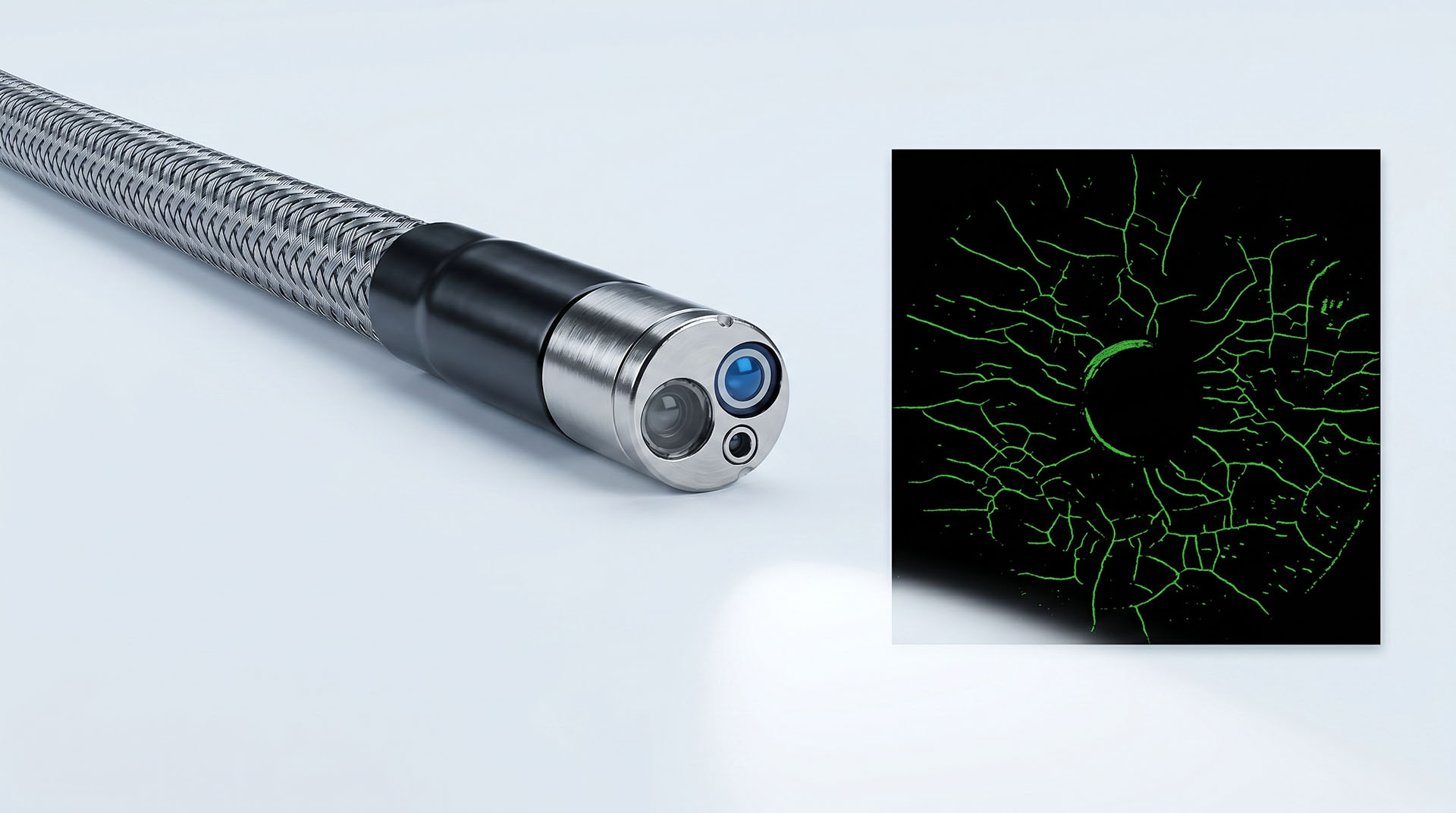
Some industrial videoscope probes integrate both a forward-view and a side-view camera. This is commonly referred to as a dual-camera probe.
The main advantage of dual camera is not simply that the probe contains two cameras. Its real value is the improvement in the inspection workflow.
A typical inspection sequence can be:
Use forward view while inserting the probe.
Locate the inspection position.
Switch to side view.
Inspect the wall or weld without removing the probe.
This can be particularly useful for:
Long tubes
Small pipework
Pharmaceutical piping
Circumferential weld inspection
Restricted-access applications
The benefit becomes even more obvious with a long probe. If the operator has already inserted several meters of probe and located the correct weld, withdrawing the whole probe simply to change the viewing direction can be inefficient and can make it difficult to find exactly the same position again.
In a large cavity, however, dual camera may add little practical value. If a forward-view camera with articulation can already be directed toward the target, the simpler configuration may provide an easier and more efficient solution.
5. What Is Depth of Field (DOF)?
Depth of Field describes the range of distances from the camera within which objects remain acceptably sharp.
For example, one optical configuration may be optimized for a short working range, while another may remain in focus over a much broader distance.
These configurations are designed for different inspection tasks.
Near-focus optics are useful for:
Small holes
Small tubes
Fine surface defects
Close weld inspection
Applications where the lens naturally operates very close to the surface
Standard or longer-focus optics are useful for:
Gearboxes
Engine chambers
Larger mechanical cavities
General maintenance inspection
Applications where the camera-to-target distance changes frequently
A common mistake is to assume that the shortest possible minimum focusing distance is automatically the best.
It is not.
If the operator normally observes a component from 50 or 100 mm away, an optical system optimized only for extremely short distances may offer little practical advantage.
The more useful question is:
At what distance will the camera actually be from the inspection surface?
6. Why Working Distance Matters
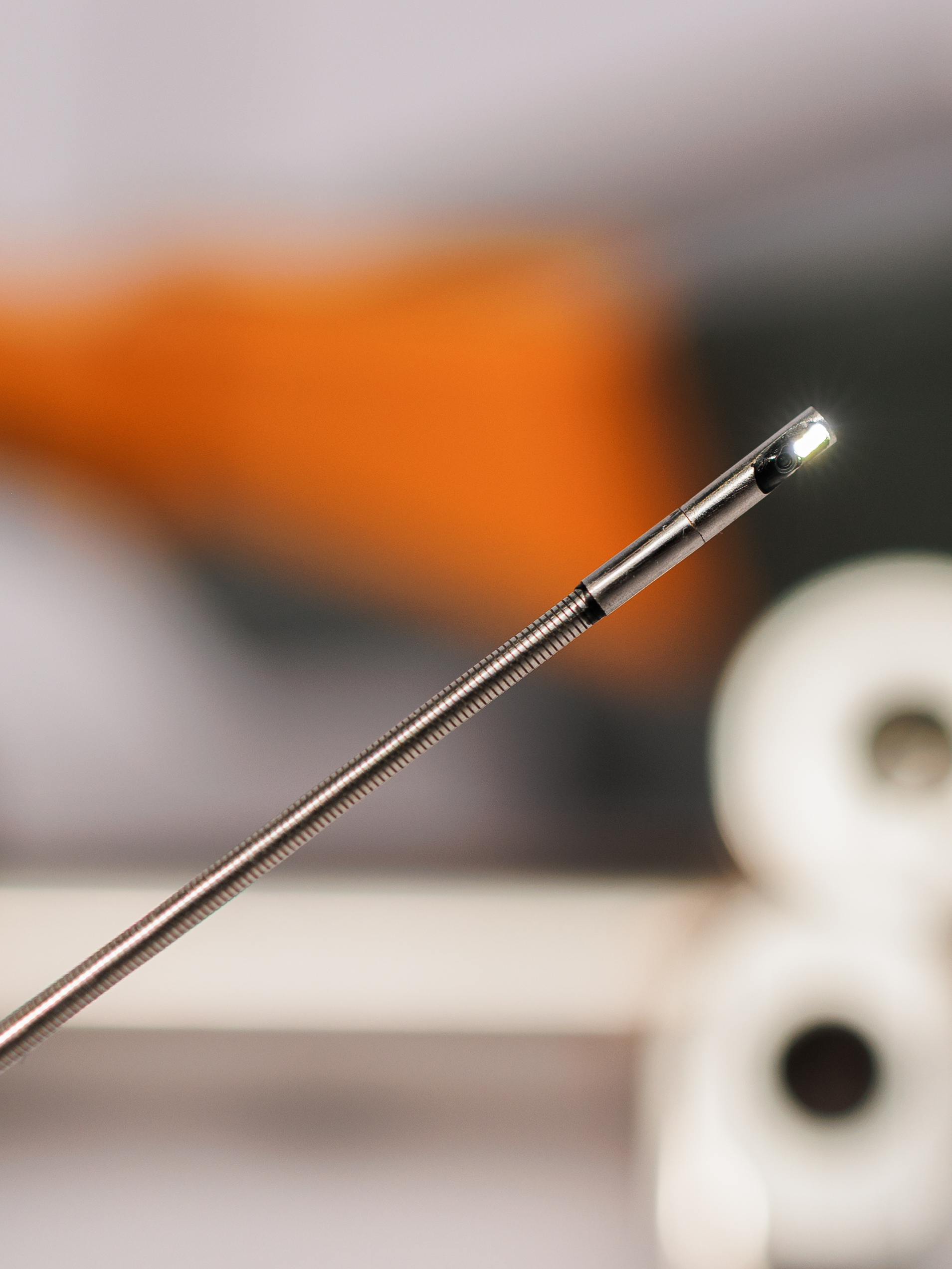
Working distance is the physical distance between the optical element and the surface being inspected.
It directly influences:
Apparent defect size
Focus
Illumination
Surface coverage
Image contrast
When the camera moves closer to a surface, a small feature occupies a larger part of the image. When the camera moves farther away, more surrounding area becomes visible but the same feature appears smaller.
Example: small tube inspection
Inside a small tube, the lens may naturally remain only a few millimeters from the tube wall. Near-focus optics can therefore provide a significant advantage.
Example: gearbox inspection
Inside a gearbox, the camera may observe gears and bearing surfaces from tens of millimeters away. A broader working range is generally more useful.
The optical configuration should therefore be selected according to the physical relationship between:
camera → inspection surface → defect size
rather than simply choosing the specification with the shortest minimum focusing distance.
7. Magnification: Bigger on the Screen Does Not Always Mean More Detail
Industrial borescope users sometimes describe an image as having more magnification when the camera moves closer to the target.
However, the apparent size of a feature on the display depends on several factors:
Working distance
Field of view
Camera resolution
Digital zoom
Display size
Moving the camera closer generally allows the feature to occupy more pixels in the captured image, which can make small defects easier to evaluate.
Digital zoom is different. Digital zoom enlarges information that has already been captured; it does not create additional optical detail.
For defect evaluation, the objective should therefore not simply be maximum magnification. The goal should be:
the correct working distance and optical configuration to capture enough real detail for reliable inspection.
8. What Is Optical Distortion?
Wide-angle lenses often introduce some degree of geometric distortion. One common example is barrel distortion, where straight features near the edge of the image can appear curved.
This can be a normal consequence of combining a wide field of view with a very compact optical system.
For general remote visual inspection, moderate distortion may have little influence on the operator's ability to identify:
Corrosion
Cracks
Pitting
Foreign objects
Surface damage
However, optical distortion becomes much more important when dimensional measurement is required.
A measurement system must use known and calibrated optical geometry before reliable dimensions can be calculated. A visually corrected image should therefore not automatically be interpreted as a calibrated measurement image.
Visual inspection and dimensional measurement are related, but they are not the same task.
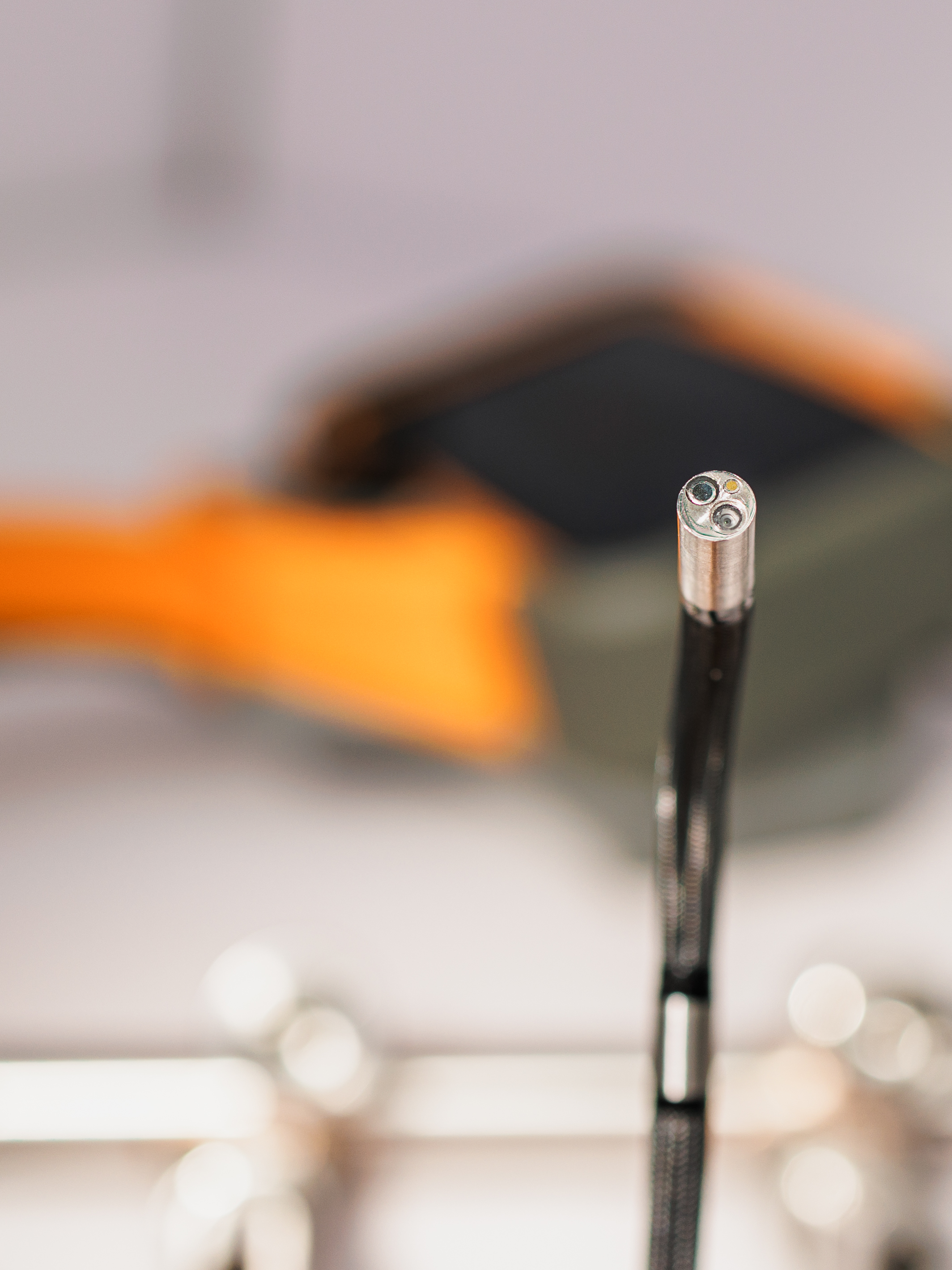
9. Probe Diameter Can Be More Important Than Optical Specifications
It is easy to focus on resolution, FOV and DOF while forgetting the most basic physical requirement:
The probe first has to reach the inspection area.
If the access opening only permits a very small probe, selecting a larger diameter simply because it offers higher resolution is not useful.
For restricted-access inspections, the priority should normally be:
Can the probe enter the access opening?
Can it reach the target?
Can the camera be positioned correctly?
Is the available image quality sufficient for the inspection task?
Only after these questions have been answered should higher resolution or additional functions become the main selection criteria.
Very small probes may involve compromises in areas such as:
Camera resolution
Illumination
Articulation capability
Mechanical durability
However, if a small-diameter probe is the only configuration that can physically reach the inspection target, access capability is more important than choosing a larger probe with better specifications on paper.
10. Longer Probe Length Is Not Automatically Better
Probe length is another specification where more is often assumed to be better.
Long probes can be necessary for:
Heat exchangers
Long pipework
Large industrial equipment
Remote inspection positions
But unnecessarily increasing the probe length can make the inspection more difficult.
As probe length increases, practical considerations may include:
Articulation response
Video signal transmission
Frame rate
Illumination
Insertion handling
Mechanical resistance
If the inspection point is only three meters from the access opening, selecting a ten-meter probe simply for extra length may reduce usability without providing any useful inspection advantage.
The correct probe length should therefore be selected according to the actual inspection path, not according to the idea that a longer probe is always more versatile.
11. A Better Way to Select Industrial Borescope Optics
Instead of beginning with a datasheet, begin with the actual inspection.
1. What exactly needs to be inspected?
Is the target a gear tooth, bearing surface, weld, corrosion area, crack, foreign object or another feature?
2. What is the smallest access point?
This determines the maximum practical probe diameter.
3. How far is the inspection area from the access point?
This determines the required working length.
4. How far will the camera be from the target surface?
This determines which depth-of-field range is useful.
5. Where is the target relative to the probe?
This helps determine whether forward view, articulation, dedicated side view or dual camera is the better solution.
6. Is the inspection space large or highly restricted?
A gearbox cavity and a small tube require completely different optical strategies.
7. What does the operator actually need to identify?
The objective may be general condition assessment, crack detection, corrosion evaluation, weld inspection, foreign-object detection or dimensional measurement.
Once these questions are answered, specifications such as FOV, DOV and DOF become much easier to interpret.
12. Application First, Specification Second
Industrial borescope optics cannot be selected reliably by comparing individual numbers.
A wider FOV is not automatically better than a narrower FOV.
A shorter minimum focusing distance is not automatically more useful.
A dual-camera probe is not automatically better than a single forward-view probe.
A longer probe is not automatically more versatile.
A higher-resolution camera is useless if the probe cannot reach the inspection area.
The best videoscope configuration is the one that matches the real inspection geometry and the actual inspection objective.
A more reliable selection process is:
Inspection object → access path → target position → working distance → viewing direction → optical specification
rather than:
Datasheet → highest specification → application
If you are unsure which probe diameter, working length, viewing direction or depth of field is appropriate, you do not need to determine every technical parameter yourself.
Send us a description, photo or drawing of the inspection area and explain what you need to see. The correct RVI configuration can then be selected according to the real application.
Frequently Asked Questions About Borescope FOV, DOV and DOF
What does FOV mean on a borescope?
FOV stands for Field of View. It describes the angular width of the area visible through the borescope lens. A wider FOV shows more surrounding area, while a narrower FOV concentrates on a smaller area. Neither is automatically better; the correct choice depends on the inspection target and working distance.
Is a wider FOV always better for industrial inspection?
No. A wide FOV is useful for orientation and viewing larger areas, but it can make small features occupy a smaller part of the image. For detailed inspection, working distance, camera resolution and illumination can be just as important as the field of view.
What is the difference between FOV and DOV?
FOV describes how wide the camera sees, while DOV describes which directionthe camera is looking. For example, a probe may have a 90° side-view DOV combined with a particular FOV.
Do I need a side-view borescope to inspect a side wall?
Not necessarily. In a large cavity, a forward-view probe with effective articulation can often be bent toward the side wall. A dedicated side-view camera becomes more useful in small tubes, blind holes and restricted spaces where there is not enough room to turn the distal tip.
What is the advantage of a dual-camera borescope?
A dual-camera probe allows the operator to use forward view for navigation and then switch to side view without removing the probe. This can significantly improve inspection efficiency in long tubes, small pipework and circumferential weld inspections.
What does DOF mean on an industrial videoscope?
DOF stands for Depth of Field. It describes the range of camera-to-object distances over which the image remains acceptably sharp. Near-focus optics are useful when the camera works very close to the target, while a broader depth of field is often more suitable for general mechanical inspection.
Is a shorter minimum focusing distance always better?
No. A very short minimum focusing distance is valuable only when the camera actually needs to operate very close to the inspection surface. For gearboxes and larger cavities, a broader working range may be more useful than an extreme near-focus configuration.
Does digital zoom improve borescope image resolution?
Digital zoom makes the displayed image larger, but it does not create additional optical information. For reliable defect evaluation, correct working distance, focus, illumination and original camera resolution are more important than digital enlargement alone.
Why do wide-angle borescope images sometimes look distorted?
Compact wide-angle lenses can introduce barrel distortion, particularly near the edges of the image. This may have little effect on general visual inspection, but calibrated optical geometry is important when accurate dimensional measurement is required.
Should I choose the smallest possible borescope probe?
Not automatically. The probe must be small enough to pass through the access path, but smaller probes can involve compromises in illumination, resolution, articulation and durability. The best choice is normally the largest probe that can comfortably reach and operate within the actual inspection geometry.
Should I buy a longer probe in case I need it in the future?
Usually only when there is a realistic need for the additional length. Excessive probe length can make insertion and handling more difficult and may affect articulation, illumination and video performance. The working length should be matched to the actual inspection path.
How do I choose the correct industrial borescope configuration?
Start with the application rather than the datasheet. Confirm the inspection object, smallest access opening, distance to the target, camera-to-surface working distance, required viewing direction and the type of defect or condition that must be identified. These factors determine the appropriate probe diameter, length and optical configuration.
Need Help Selecting the Right Videoscope?
Choosing a videoscope does not require you to become an expert in every optical specification.
Tell us:
what you need to inspect,
the available access size,
how far the inspection point is from the access opening,
and what you need to see.
A photo, drawing or short description is often enough for an initial evaluation.
Application first. Clear recommendation. No unnecessary complexity.