How to Choose an Industrial Videoscope Probe Sheath Tungsten Braid Stainless-Steel Spring Tube or Polyimide
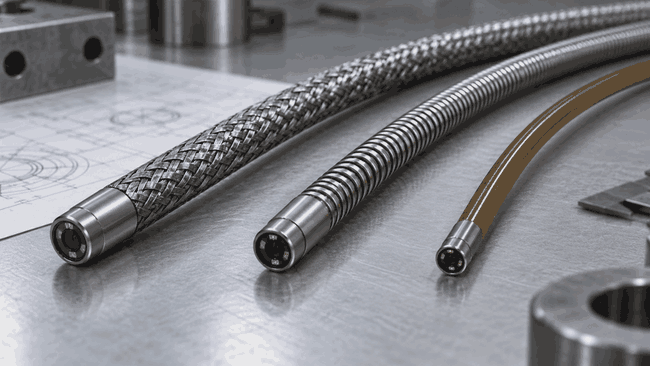
Compare tungsten braid, stainless-steel spring tube and polyimide (PI) sheaths for industrial videoscopes by durability, flexibility and access size.
The outer sheath of an industrial videoscope probe is not simply a cosmetic covering. It influences how the probe behaves during insertion, how well it tolerates rubbing and mechanical contact, how small the overall probe diameter can be, and how easily the probe can pass through bends or restricted access points.
Three common protection concepts are tungsten-wire braid, stainless-steel spring tube, and polyimide (PI). None is universally the best choice. The correct sheath depends on the inspection path, access diameter, surface condition, mechanical risk and required probe flexibility.
Quick Answer: Which Probe Sheath Should You Choose?
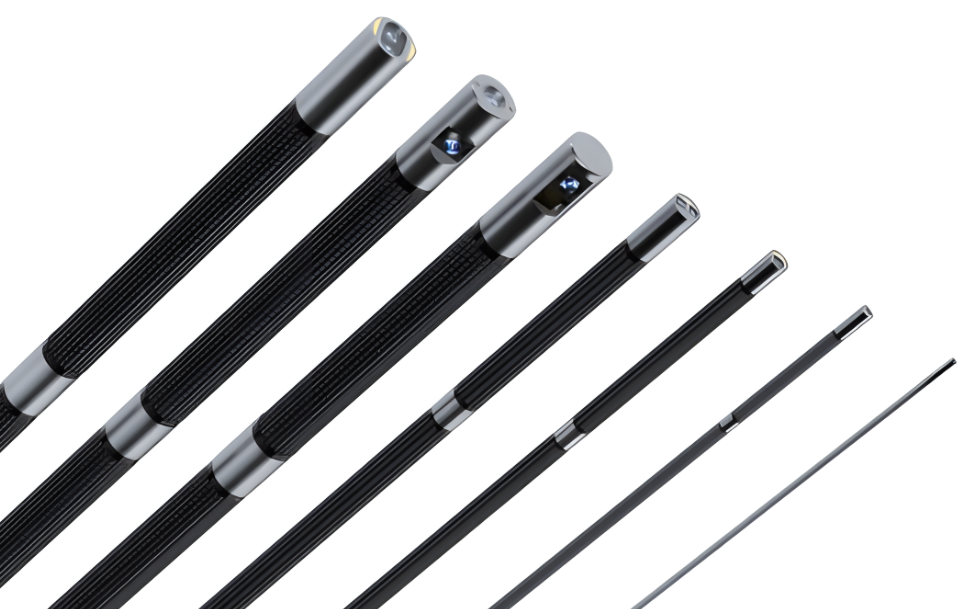
For most general industrial inspections, a tungsten-braided sheath offers a good balance between flexibility and mechanical protection. A stainless-steel spring tube is useful where stronger structural protection and resistance to accidental compression are important, especially when the inspection path is relatively straight or moderately curved. A polyimide (PI) sheath is particularly valuable in ultra-thin probes where minimizing probe diameter is more important than maximizing heavy-duty mechanical protection.
| Sheath Type | Main Advantage | Best Suited For | Main Trade-Off |
|---|---|---|---|
| Tungsten-Wire Braid | Good balance of abrasion protection and flexibility | General industrial inspection, castings, engines, gearboxes, turbines and repeated insertion | Braided surface can eventually wear or become damaged after repeated contact with sharp or abrasive edges |
| Stainless-Steel Spring Tube | Strong mechanical support and good resistance to accidental crushing | Hard mechanical environments, cast components and relatively straight or moderately curved access paths | Usually less flexible than a thin polymer sheath and may create more insertion resistance in tight bends |
| Polyimide (PI) | Very thin wall and excellent dimensional efficiency | Ultra-thin probes, miniature passages and highly restricted access | Less mechanical protection reserve against crushing, pinching and severe edge impact than a heavier metallic construction |
What Does the Probe Sheath Actually Protect?
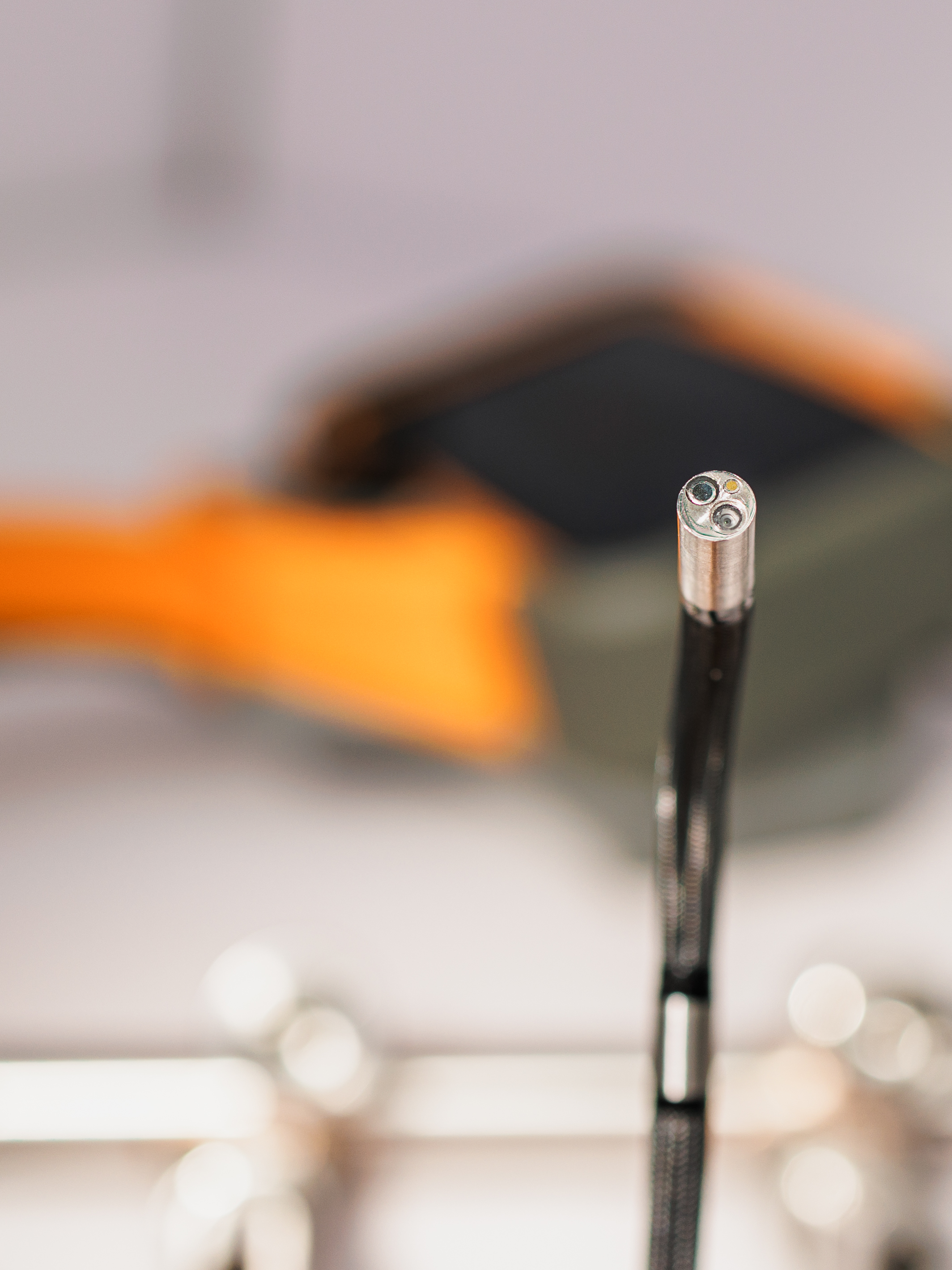
Inside a flexible videoscope probe are several sensitive components. Depending on the probe design, these may include the video signal cable, illumination conductors or fibers, articulation wires, electrical wiring and structural support elements. The outer insertion tube must protect these components while still allowing the probe to bend and travel through the inspection path.
This creates a basic engineering conflict:more mechanical protection normally requires more material or structural stiffness, while better access to very small or highly curved passages requires a thinner and more flexible construction.Probe sheath selection is therefore always a compromise between durability, diameter and maneuverability.
1. Tungsten-Wire Braided Sheath
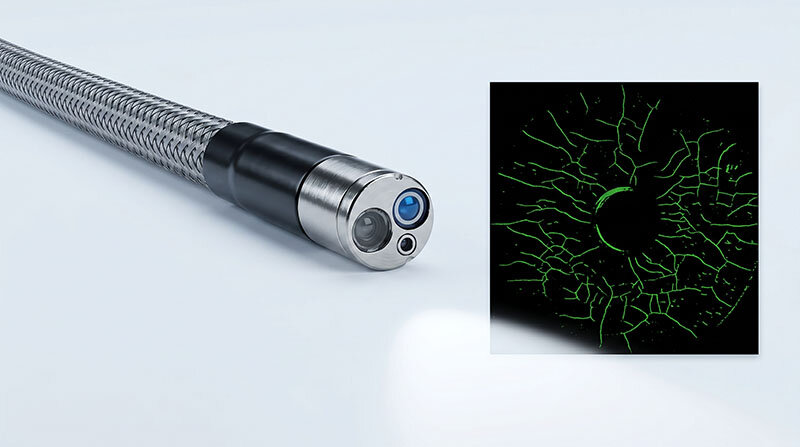
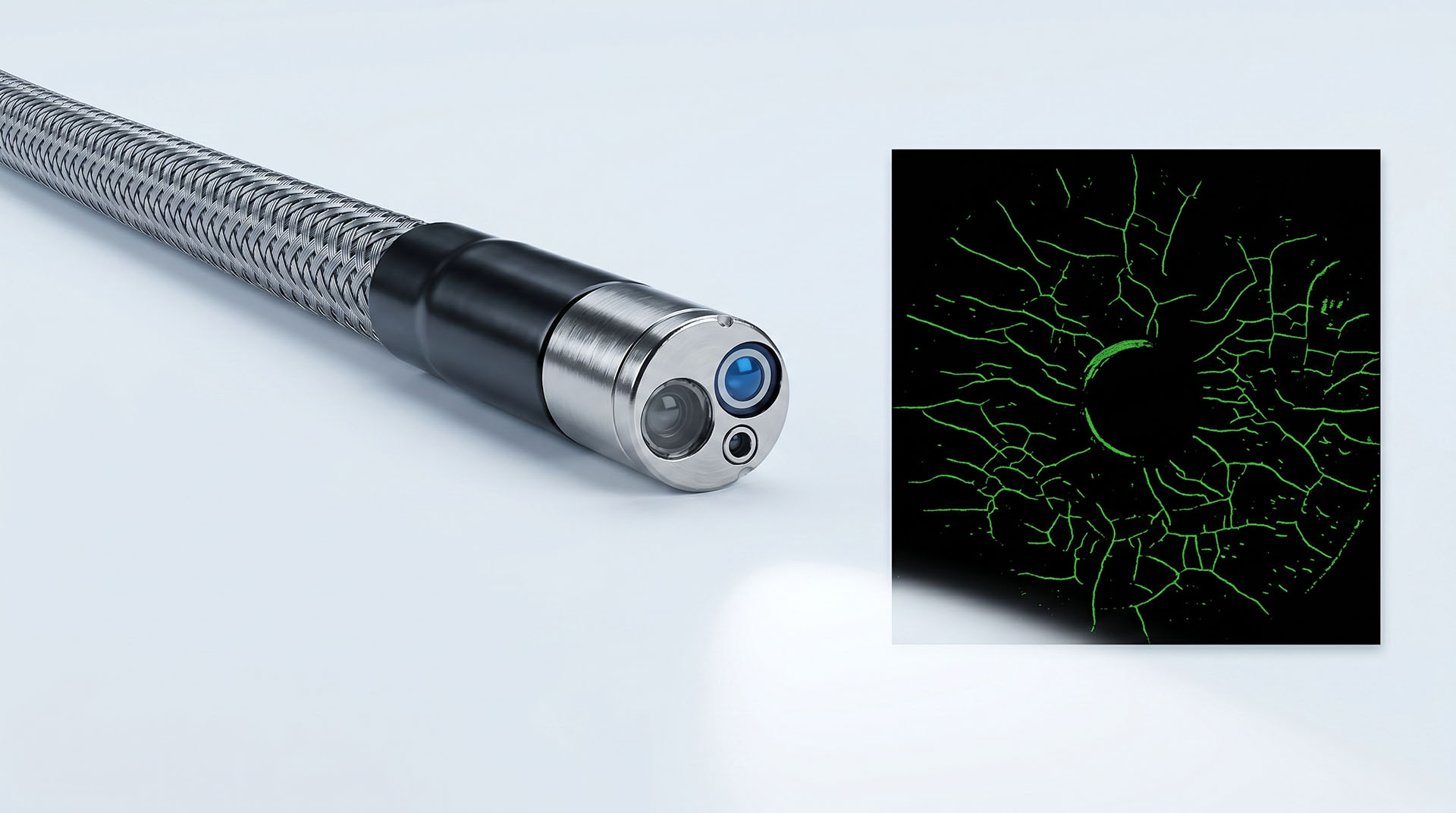
Tungsten-wire braid is widely used on professional industrial videoscope insertion tubes. The fine metallic braid surrounds the probe and forms a flexible protective layer that can tolerate repeated sliding against metal surfaces better than an unprotected polymer jacket.
Advantages of Tungsten Braid
Good abrasion protection: suitable for repeated contact with machined metal, cast surfaces and industrial components.
Good flexibility: the woven construction can bend with the probe rather than behaving like a rigid metal tube.
Suitable for repeated industrial use: a practical choice for daily inspection of engines, gearboxes, turbines, castings and mechanical assemblies.
Good compromise between protection and maneuverability: this is one reason braided metallic insertion tubes are common on professional industrial videoscopes.
Limitations of Tungsten Braid
Tungsten braid is highly protective, but it is not indestructible. Repeated dragging over sharp edges, burrs or rough casting surfaces can eventually wear the braid. If individual wires become damaged or lifted, the surface can begin to snag during insertion or withdrawal.
The braid also does not eliminate crushing risk. A probe can still be damaged if it is trapped between mechanical parts, pinched in a closing joint or forced through an opening that is too small.
For this reason, tungsten braid should be viewed as a durable flexible protection layer, not as armor that allows unlimited force during insertion.
2. Stainless-Steel Spring Tube Sheath
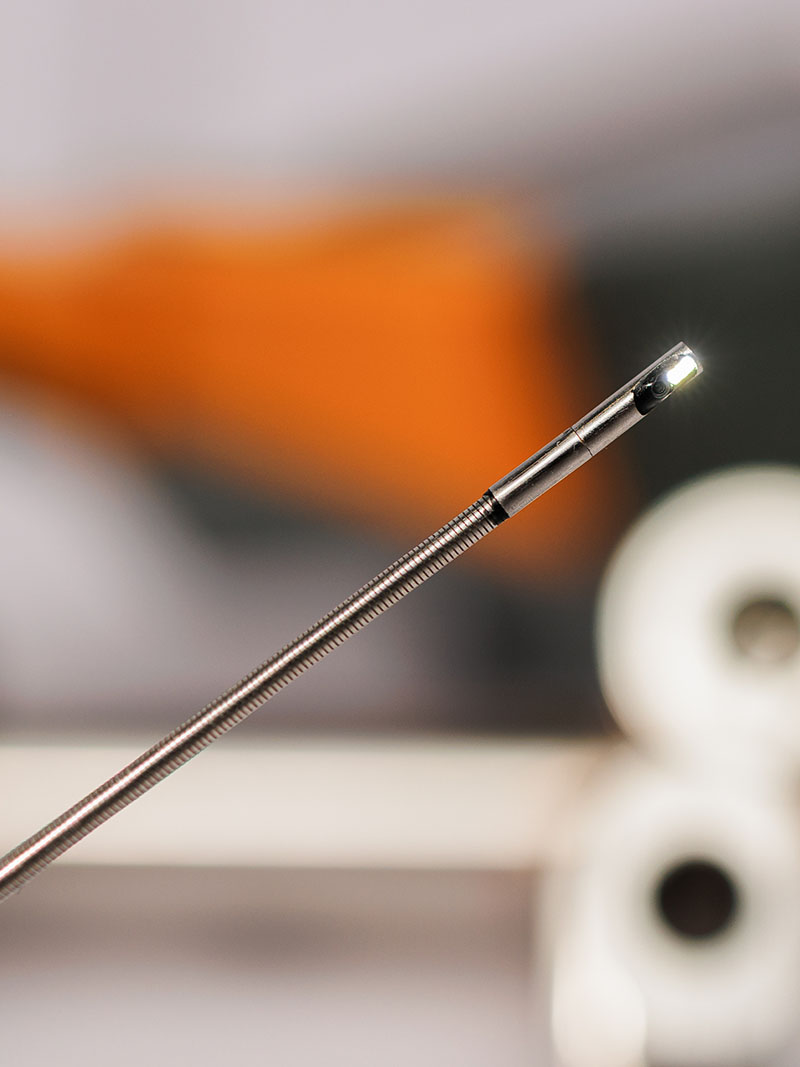
A stainless-steel spring tube uses a helically wound metallic structure to protect and support the insertion tube. Depending on the probe design, the spring tube may be used as the external protection layer or as part of the internal structural construction underneath another jacket or braid.
The spring geometry allows the tube to bend while still providing substantially more structural support than a simple thin polymer covering.
Advantages of Stainless-Steel Spring Tube
Strong mechanical support: useful where accidental compression or lateral mechanical contact is a significant risk.
Good crush resistance: the spring structure helps protect internal components from moderate external loads.
Durable in hard mechanical environments: suitable for repetitive insertion into metal components and industrial assemblies.
Useful pushability: additional structural stiffness can make the probe easier to advance through certain straight or moderately curved passages.
Limitations of Stainless-Steel Spring Tube
The same stiffness that improves mechanical protection can reduce maneuverability. In small passages with several tight bends, a spring-tube probe may require more insertion force than a thinner or more flexible construction.
Its external spiral geometry can also produce more sliding resistance at sharp transitions than a smooth polymer surface. For applications where very low insertion friction or extremely small probe diameter is critical, another sheath type may be preferable.
3. Polyimide (PI) Sheath
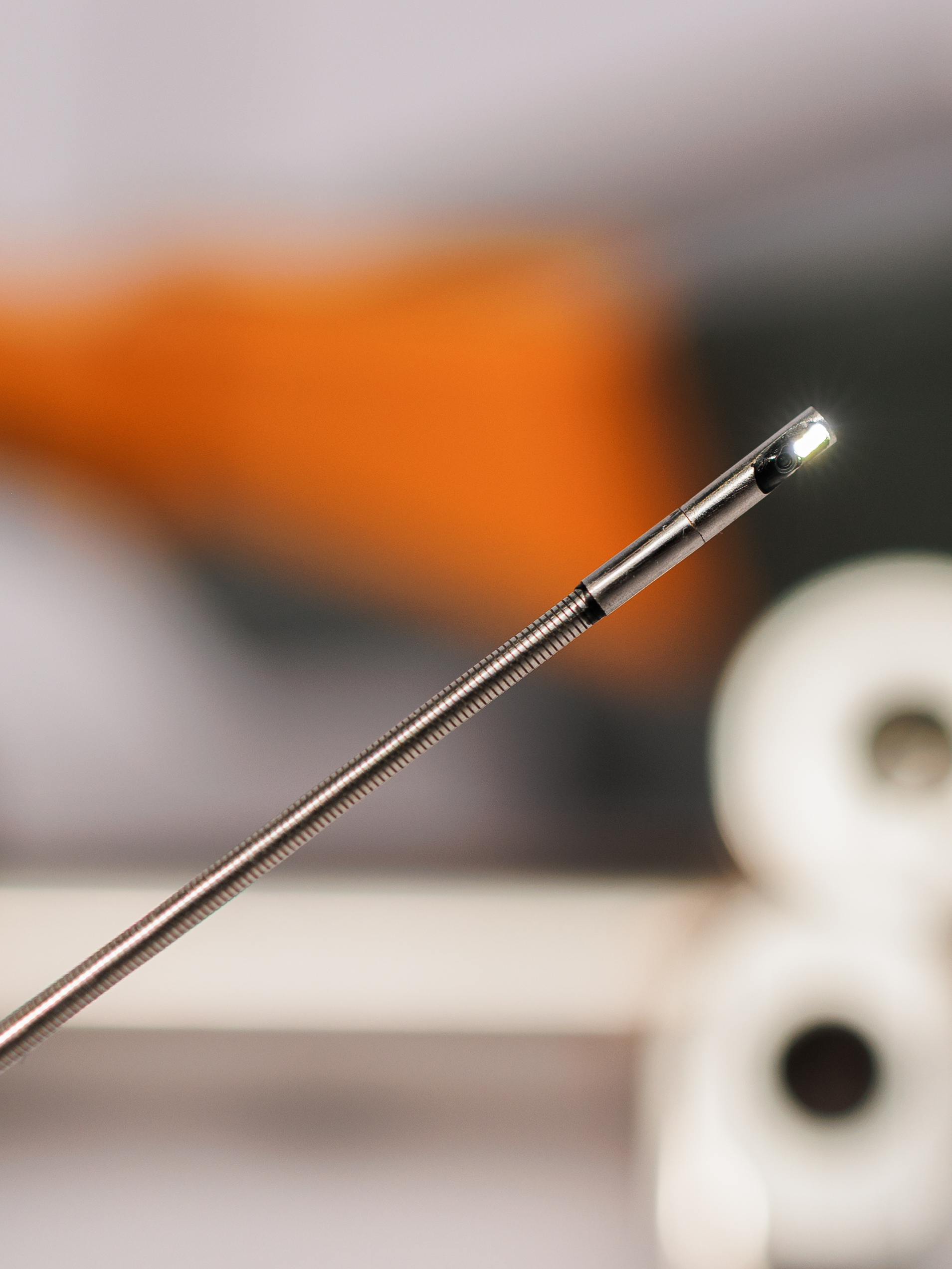
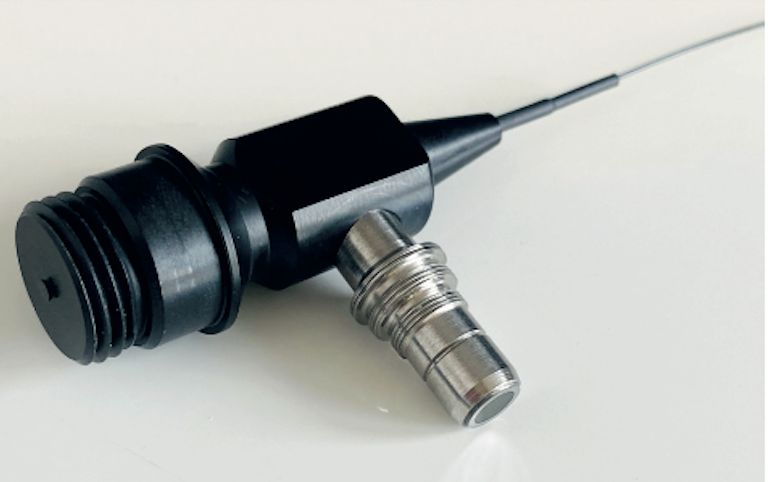
Polyimide is a high-performance polymer that can be manufactured with extremely thin wall thickness while maintaining useful mechanical strength. This makes PI particularly attractive for miniature and ultra-thin videoscope probes, where every fraction of a millimeter affects whether the probe can enter the inspection opening.
Advantages of Polyimide
Very thin wall construction: helps minimize the final outside diameter of the probe.
Smooth external surface: useful when passing through very small openings or close-fitting channels.
Good abrasion resistance for a thin polymer: PI retains useful mechanical properties even at small dimensions.
Good chemical and thermal stability as a material: useful where a conventional low-performance plastic would be unsuitable.
Ideal for ultra-thin probe designs: especially where access diameter is the primary design limitation.
Limitations of Polyimide
A thin PI sheath should not be compared directly with a much heavier metallic protection system. Although polyimide itself has good tensile and abrasion properties, an ultra-thin PI wall cannot provide the same reserve against severe crushing, pinching or impact from sharp metal edges as a metal braid or spring structure.
This is especially important with very small-diameter probes. An ultra-thin probe may fit through an opening that a conventional probe cannot enter, but the reduced diameter also means less space is available for structural reinforcement. Such probes should therefore be handled as precision inspection instruments rather than heavy-duty insertion tools.
Tungsten Braid vs Stainless-Steel Spring Tube vs PI
| Selection Factor | Tungsten Braid | Stainless-Steel Spring Tube | Polyimide (PI) |
|---|---|---|---|
| Abrasion Protection | Very good | Very good | Good for its wall thickness |
| Crush Protection | Good, depending on internal structure | Very good | Limited compared with metallic reinforcement |
| Flexibility | Good | Moderate to good, depending on spring design | Very good in miniature constructions |
| Minimum Practical Probe Diameter | Moderate | Moderate | Excellent for ultra-thin designs |
| Surface Smoothness | Braided texture | Spiral / spring texture | Smooth |
| Typical Priority | Balanced industrial durability | Mechanical protection | Minimum diameter and restricted access |
Which Sheath Is Best for Daily Industrial Inspection?
For general industrial work where the probe is repeatedly inserted into engines, gearboxes, castings, turbines or machinery, a tungsten-braided insertion tube is often the most balanced solution. It combines flexible navigation with useful protection against rubbing and routine mechanical contact.
However, the inspection geometry matters more than the material name alone. If the probe must repeatedly enter a relatively straight metallic passage where crushing and external mechanical contact are the main risks, a stainless-steel spring-tube construction may be more appropriate.
If the access opening is so small that a conventional metallic sheath would make the probe too large, a PI-based ultra-thin construction may be the only practical solution.
Which Sheath Is Best for Small-Diameter Inspection?
When access diameter becomes extremely restricted, probe construction changes significantly. A heavy braided or spring structure consumes valuable radial space. PI can be manufactured as a very thin protective layer, allowing more of the available diameter to be used for the camera, illumination and signal components.
This is why ultra-thin videoscope selection should not focus only on image resolution. The engineer should also consider how the smaller diameter affects mechanical protection, illumination, articulation, minimum bend radius and expected service life.
Which Sheath Is Best for Rough Castings or Sharp Metal Edges?
For repeated inspection of rough cast surfaces, machined passages or components with significant edge contact, a metallic protection system is generally preferred. Tungsten braid provides a good combination of abrasion protection and flexibility, while a stainless-steel spring construction can provide additional structural support where crushing or mechanical compression is a concern.
Even with a metallic sheath, sharp burrs should be avoided whenever possible. The bending section and distal camera tip are normally more vulnerable than the main insertion tube, so forcing the probe around a sharp edge can still damage the scope.
Do Not Choose a Probe Only by the Outer Sheath Material
Two probes using the same nominal sheath material can behave very differently. Actual performance depends on the complete insertion-tube construction, including:
Probe outside diameter
Working length
Internal coil or structural reinforcement
Number and arrangement of articulation wires
Bending-section design
Camera-tip length
Outer coatings and sealing layers
Required waterproofing or fluid resistance
Minimum bend radius
For this reason, sheath material should be considered one part of the probe-selection process rather than a standalone specification.
Important Note on Temperature and Chemical Resistance
Material data for tungsten, stainless steel or polyimide should not be used as the operating limit of the complete videoscope. A probe also contains a camera sensor, illumination system, electrical conductors, adhesives, seals, coatings and articulation components. These parts may have much lower temperature or chemical-resistance limits than the outer sheath itself.
Always use the operating-temperature and fluid-resistance specification of the complete probe configuration rather than the theoretical capability of the sheath material alone.
Practical Selection Guide
| Inspection Requirement | Recommended Starting Point |
|---|---|
| General industrial inspection with repeated insertion | Tungsten braid |
| Rough metallic environment with higher crush risk | Stainless-steel spring tube |
| Extremely restricted access or ultra-thin probe requirement | Polyimide (PI) |
| Multiple tight bends | Prioritize overall probe flexibility and bend radius, not sheath material alone |
| Sharp edges or heavy abrasion | Prefer metallic protection and control insertion technique carefully |
| Chemical or elevated-temperature environment | Check the complete probe specification before selecting a sheath |
Frequently Asked Questions
Which industrial videoscope probe sheath is the most durable?
There is no single most durable sheath for every failure mode. Tungsten braid performs well against repeated abrasion, while a stainless-steel spring tube can provide stronger structural protection against accidental compression. PI is optimized more toward thin-wall construction and restricted access than maximum crush resistance.
Is tungsten braid better than stainless steel?
Not necessarily. Tungsten braid is usually selected when flexibility and abrasion protection must be balanced. A stainless-steel spring tube can be preferable when stronger structural support is required. The inspection path and mechanical risks should determine the choice.
Why is polyimide used on ultra-thin videoscope probes?
Polyimide can form a very thin, strong and dimensionally stable outer layer. This allows the probe diameter to be reduced without using a relatively thick metallic protective structure, which is especially valuable when access clearance is extremely limited.
Does a PI sheath mean the complete probe can withstand very high temperatures?
No. Polyimide itself has excellent thermal stability, but the complete videoscope contains electronics, optics, adhesives, seals and other materials. The operating temperature of the finished probe may therefore be much lower than the theoretical temperature capability of PI. Always follow the complete probe specification.
Can a metallic probe sheath be used around live electrical components?
A metallic braid or spring construction may be electrically conductive depending on the probe design. Do not assume that a videoscope insertion tube provides electrical insulation. Inspection of energized electrical equipment requires a probe specifically approved for that application.
Which sheath should I choose for a small access hole?
First determine the maximum permitted probe diameter and required working clearance. If a conventional tungsten-braided or spring-protected probe cannot fit, an ultra-thin PI-based probe may be appropriate. However, smaller diameter normally involves greater mechanical compromises, so the smallest possible probe is not automatically the best choice.
Conclusion
The best videoscope probe sheath depends on what the probe must survive and where it must travel.Tungsten braid is a strong general-purpose choice for industrial inspection,stainless-steel spring tube prioritizes structural mechanical protection, and polyimide (PI) enables very small probe diameters for restricted-access inspection.
The correct engineering decision is therefore not simply “which material is strongest?” It is:which combination of probe diameter, flexibility, abrasion resistance and mechanical protection best matches the real inspection path?