
Rigid Endoscope Light Guide Connectors Explained
Learn how to identify rigid endoscope light guide connectors, including Storz, Olympus, Wolf and ACMI interfaces, cable ends and fibre bundle sizes.
Rigid Endoscope Light Guide Connectors Explained: Storz, Olympus, Wolf and ACMI
Rigid endoscopes normally use a separate illumination system. Light from an LED or cold-light source is transmitted through a fibre-optic light guide cable and delivered into the inspection area through the endoscope’s built-in illumination fibres.
Although the optical principle is simple, connector compatibility can be confusing. A light guide cable has two different ends, and each end may follow a different connector standard. Matching only the brand name of the light source or endoscope is therefore not enough.
The Three Interfaces That Must Not Be Confused
A complete rigid endoscope system may include three separate interfaces:
Eyepiece interface
Instrument-side light guide connector
Light-source-side light guide connector
These interfaces perform different functions and are not interchangeable.
1. Eyepiece Interface
The eyepiece transmits the optical image to the operator or to a camera adaptor.
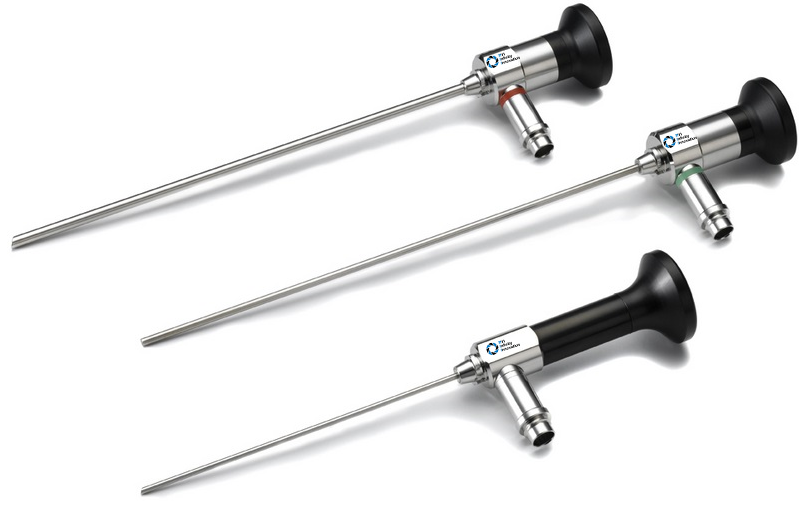
Many industrial rigid endoscopes use a standard 32 mm DIN eyepiece. A camera adaptor can be attached to this eyepiece and then connected to a C-mount camera.
The eyepiece specification does not determine the light guide cable connection.
2. Instrument-Side Connector
This is the end of the light guide cable that connects to the rigid endoscope.
It may also be described as:
Distal connector
Scope connector
Endoscope connector
Instrument connector
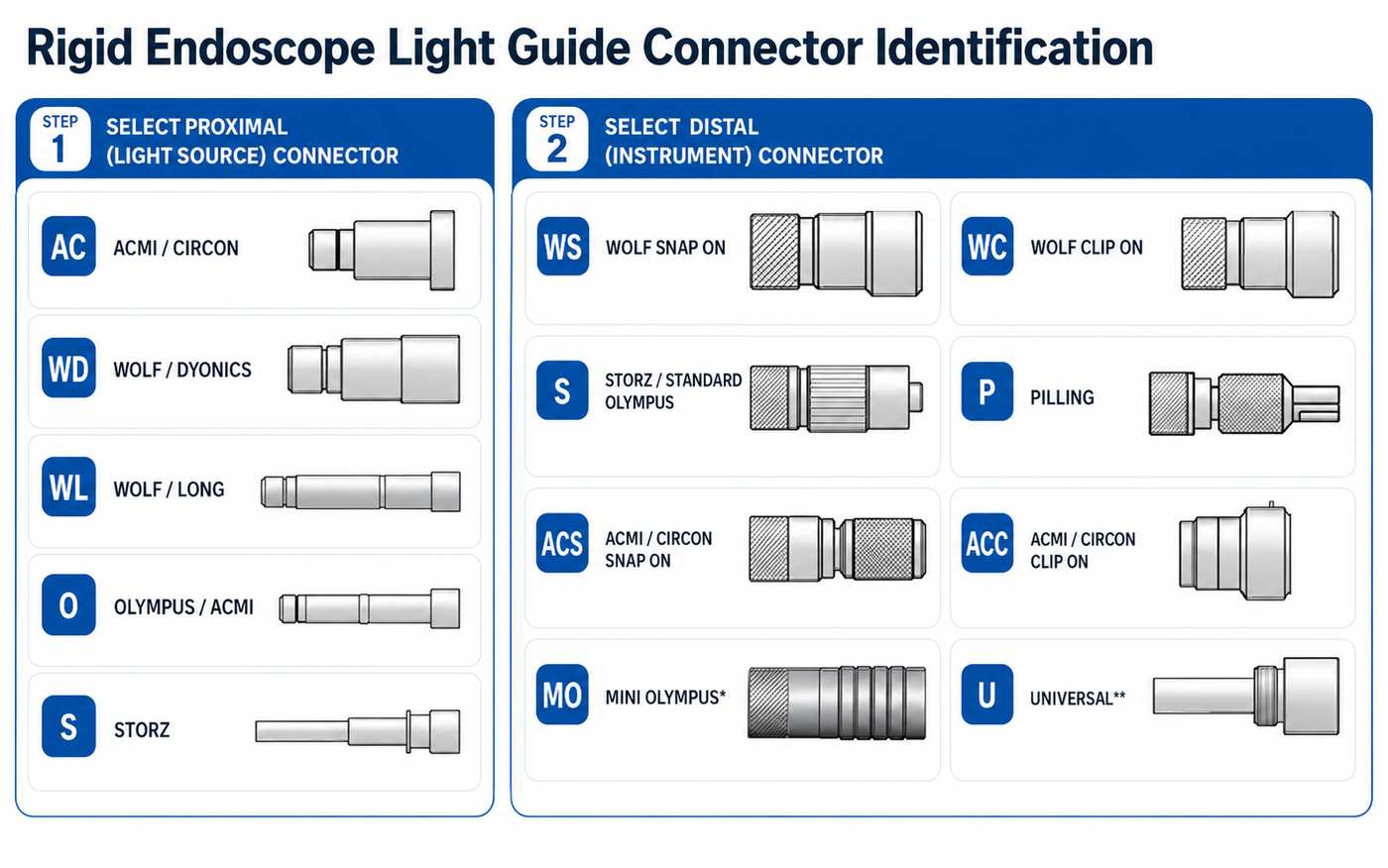
Common instrument-side interfaces include:
Storz / Standard Olympus
Wolf snap-on
Wolf clip-on
ACMI / Circon snap-on
ACMI / Circon clip-on
Mini Olympus
Pilling
Universal connectors
3. Light-Source-Side Connector
This is the end of the cable that connects to the LED, xenon or other cold-light source.
It may also be described as:
Proximal connector
Machine connector
Generator connector
Light-source connector
Common light-source-side interfaces include:
Storz
Olympus / ACMI
ACMI / Circon
Wolf / Dyonics
Wolf long
Important: The light-source end and instrument end do not need to use the same connector standard.
For example, one cable may have an Olympus / ACMI connector on the light-source side and a Storz / Standard Olympus connector on the instrument side.
Why Brand Names Alone Can Be Misleading
Connector terminology developed over many years across medical and industrial endoscopy systems. As a result, the same brand may be associated with several different connector forms.
For example, the description Storz / Standard Olympus usually refers to a commonly compatible instrument-side connector. It does not mean that every Olympus light source, Olympus cable or Olympus connector uses the same mechanical interface.
Similarly, an “Olympus cable” may only describe the connector fitted on the light-source side. The instrument-side connector may still be Storz, ACMI, Wolf or another type.
The safest approach is always to identify both cable ends separately.
Main Connector Families
Storz
Storz is one of the most common connector systems used with rigid endoscopes.
On the instrument side, the Storz-style connector is frequently grouped together with Standard Olympus because many standard Olympus instrument interfaces use a compatible geometry.
However, the Storz light-source connector is a separate mechanical design. A Storz scope connection does not automatically mean that the opposite end of the cable also needs to be Storz.
A Storz-to-Storz cable is a straightforward configuration when both the endoscope and the light source use Storz-compatible interfaces.
Standard Olympus
Standard Olympus is often compatible with the Storz instrument-side connection.
This is useful when a customer already has an Olympus light source and cable but needs to replace only the rigid endoscope. If the cable’s instrument end is identified as Storz / Standard Olympus, it can normally connect directly to a Storz-compatible rigid endoscope.
Nevertheless, Olympus has used different connector systems across different product generations. Compatibility should therefore be confirmed using the exact model number or clear interface photographs.
Mini Olympus
Mini Olympus is a smaller connector design and should not be confused with the standard Olympus/Storz-compatible instrument connection.
A Mini Olympus cable generally requires a matching instrument interface or a suitable adaptor.
ACMI / Circon
ACMI and Circon interfaces are common in older and specialised endoscopy systems.
Several versions exist, including:
Standard ACMI / Circon
ACMI / Circon snap-on
ACMI / Circon clip-on
ACMI-compatible light-source connectors
The words “snap-on” and “clip-on” describe the mechanical locking method. Two ACMI-labelled connectors may therefore still be mechanically incompatible.
Richard Wolf
Wolf systems use several different connector forms, including:
Wolf snap-on
Wolf clip-on
Wolf / Dyonics
Wolf long
These versions differ in length, locking method and mechanical shape. A connector described only as “Wolf” is not specific enough for reliable ordering.
Pilling and Universal Connectors
Pilling is a dedicated instrument-side connector type found on certain endoscopy systems.
Universal connectors are designed to cover a wider range of instruments, but “universal” should not be interpreted as guaranteed compatibility with every endoscope.
Mechanical fit, fibre alignment and light transmission must still be checked.
Fibre-Optic Bundle Size
Connector compatibility is only one part of cable selection. The active fibre bundle diameter also affects illumination performance.
| Bundle Size | Typical Characteristic | Selection Consideration |
|---|---|---|
| 2.5 mm | Compact and lightweight | Suitable for smaller instruments and moderate illumination requirements |
| 3.5 mm | General-purpose balance | Common choice for many industrial rigid-endoscope systems |
| 4.8 mm | Higher potential light transmission | Useful for larger cavities, longer scopes or stronger illumination requirements |
2.5 mm Fibre Bundle
A smaller bundle is lighter and more compact. It may be suitable for smaller instruments and applications where extremely high illumination is not required.
3.5 mm Fibre Bundle
A 3.5 mm bundle is a common general-purpose option and provides a practical balance between cable size and light transmission.
4.8 mm Fibre Bundle
A larger bundle can transmit more illumination and may be useful for larger cavities, longer rigid endoscopes or applications requiring stronger light output.
However, the largest cable is not automatically the best choice. The effective illumination is limited by the smallest optical path in the complete system, including:
Light-source output aperture
Cable fibre bundle
Connector alignment
Endoscope illumination bundle
Cable condition and cleanliness
Using a 4.8 mm cable with an instrument designed around a much smaller illumination bundle may provide little practical improvement.
Cable Length and Light Transmission
Cable length should also be selected carefully.
A longer light guide cable offers more installation flexibility, but it may introduce:
Slightly higher optical loss
More difficult cable management
Greater risk of bending or accidental damage
Additional weight around a fixed inspection station
For most stationary inspection systems, the shortest practical cable length is normally preferable.
The cable should not be bent below its permitted bending radius. Excessive bending can break individual glass fibres and gradually reduce light output.
Common Ordering Mistakes
Assuming an Olympus Cable Fits Every Olympus Product
Olympus has used more than one connector design. Always confirm whether the connector is Standard Olympus, Mini Olympus or another version.
Checking Only the Light-Source Side
A cable that fits the customer’s light source may still be incompatible with the rigid endoscope.
Both ends must be specified.
Ordering by Brand Name Instead of Connector Shape
“Wolf cable” or “Olympus cable” is not a complete specification. The exact connector family and locking mechanism must be identified.
Ignoring Fibre Bundle Diameter
A cable may connect mechanically but still provide poor illumination if the active fibre bundle is too small or badly aligned.
Assuming an Adaptor Solves Every Compatibility Issue
An adaptor can solve a mechanical mismatch, but it may also introduce:
Additional optical loss
Mechanical play
Increased connector length
Reduced stability
More components that can become loose or contaminated
A cable with the correct direct connector combination is normally preferable.
What Information Should Be Provided Before Ordering?
To confirm compatibility, provide the following information:
Light source manufacturer
Light source model number
Existing light guide cable manufacturer
Cable part number, if available
Clear photograph of the light-source-side connector
Clear photograph of the instrument-side connector
Rigid endoscope manufacturer and model
Required cable length
Required fibre bundle diameter
Whether an adaptor is already installed
A photograph should show the complete connector shape, locking feature and front optical opening. A close-up photograph alone may not be sufficient to identify the connector.
Compatibility With RVI Infinity Innovation Rigid Endoscopes
Our standard rigid endoscope configuration uses:
DIN 32 mm eyepiece
Storz-compatible instrument-side light connector
The standard light guide cable configuration can be supplied with:
Storz instrument-side connector
Storz light-source-side connector
When a customer already has an Olympus illumination system, the existing cable may also be usable if its instrument-side connection is the Standard Olympus / Storz-compatible type.
Before confirming compatibility, we recommend checking the light source model, cable part number and photographs of both cable ends.
Final Selection Checklist
Which end connects to the light source?
Which end connects to the endoscope?
What is the exact connector type on each side?
Is the Olympus interface standard or mini?
Is the Wolf interface snap-on, clip-on or long?
What fibre bundle diameter is required?
What cable length is practical?
Is an adaptor necessary?
Are the optical faces clean and undamaged?
Has compatibility been confirmed using model numbers or photographs?
Frequently Asked Questions
Are Storz and Standard Olympus light guide connectors compatible?
On the instrument side, many Standard Olympus connectors use the same or a compatible connection style as Storz. They are therefore often described as Storz / Standard Olympus.
This does not mean that every Olympus connector is compatible. Olympus has used different interfaces across product generations, including Mini Olympus versions.
Can I use an Olympus light guide cable with a Storz rigid endoscope?
Yes, in many cases. If the instrument-side end of the Olympus cable is the Standard Olympus/Storz-compatible type, it can normally connect directly to a Storz-compatible rigid endoscope without an adaptor.
Does an Olympus light source require an Olympus connector on both ends of the cable?
No. The two ends of a light guide cable are selected independently.
For example, a cable may use Olympus / ACMI on the light-source side and Storz / Standard Olympus on the instrument side.
What is the difference between the proximal and distal connectors?
The proximal connector is the end connected to the light source or illumination generator.
The distal connector is the end connected to the rigid endoscope or other instrument.
Is a Storz-to-Storz cable always required for a Storz rigid endoscope?
No. Only the instrument-side connector must match the Storz-compatible rigid endoscope.
The light-source-side connector should match the customer’s light source.
Are all Wolf light guide connectors the same?
No. Wolf systems may use several different connector styles, including Wolf snap-on, Wolf clip-on, Wolf / Dyonics and Wolf long.
Are ACMI and Circon connectors interchangeable?
ACMI and Circon are often grouped together, but several mechanical versions exist, including standard, snap-on and clip-on forms.
The exact connector form must be confirmed.
What is the difference between Standard Olympus and Mini Olympus?
Standard Olympus commonly refers to an instrument-side connection that is often compatible with Storz.
Mini Olympus is a smaller and mechanically different interface and may require a dedicated adaptor.
How do I identify an unknown light guide connector?
Provide the light source brand and model, cable part number, photographs of both cable ends, the endoscope brand and model, and basic connector dimensions if available.
Can connector compatibility be confirmed from a photograph alone?
A clear photograph is often sufficient for initial identification, but final confirmation may still require a model number, part number, dimensional check, test fitting or manufacturer documentation.
What fibre bundle diameter should I choose?
Common fibre bundle diameters include 2.5 mm, 3.5 mm and 4.8 mm.
A larger bundle can generally transmit more light, but only when the complete optical path supports it.
Will a larger fibre bundle always produce a brighter image?
Not necessarily. Brightness also depends on light source output, connector alignment, endoscope illumination bundle size, cable length, fibre condition, cleanliness and the inspection cavity.
Can an adaptor solve any connector mismatch?
An adaptor can solve many mechanical compatibility problems, but it may introduce optical loss, additional length or reduced mechanical stability.
A direct connector combination is normally preferable.
Can I reuse an existing light source and cable when replacing only the rigid endoscope?
Yes. Many customers replace only the damaged or outdated rigid endoscope while continuing to use their existing light source and cable, provided the interfaces and optical performance are compatible.
Why is the light output weak even though the cable fits correctly?
Mechanical compatibility does not guarantee good optical performance.
Weak illumination may result from broken fibres, dirty optical surfaces, poor alignment, an undersized fibre bundle, excessive cable length, a low-output light source or a large inspection cavity.
How should fibre-optic light guide cables be handled?
Avoid tight bending, twisting during connection, pulling by the connector, dropping connectors, contaminating optical faces and operating with damaged or overheated connectors.
Store the cable in a loose coil.
What information is required for a complete quotation?
Specify the rigid endoscope diameter, working length, direction of view, field of view, eyepiece standard, both light guide connector types, fibre bundle diameter, cable length, light source requirement, camera requirement and any required adaptors.
Conclusion
Rigid endoscope light guide cables are not defined by a single connector. Each cable is a combination of a light-source-side interface, an instrument-side interface, a fibre bundle diameter and a cable length.
The most important rule is simple: always identify both ends of the cable separately.
A connector described as Storz, Olympus, Wolf or ACMI on one side does not automatically define the connector on the other side. Confirming the complete configuration before ordering prevents unnecessary adaptors, weak illumination and incompatible equipment.